
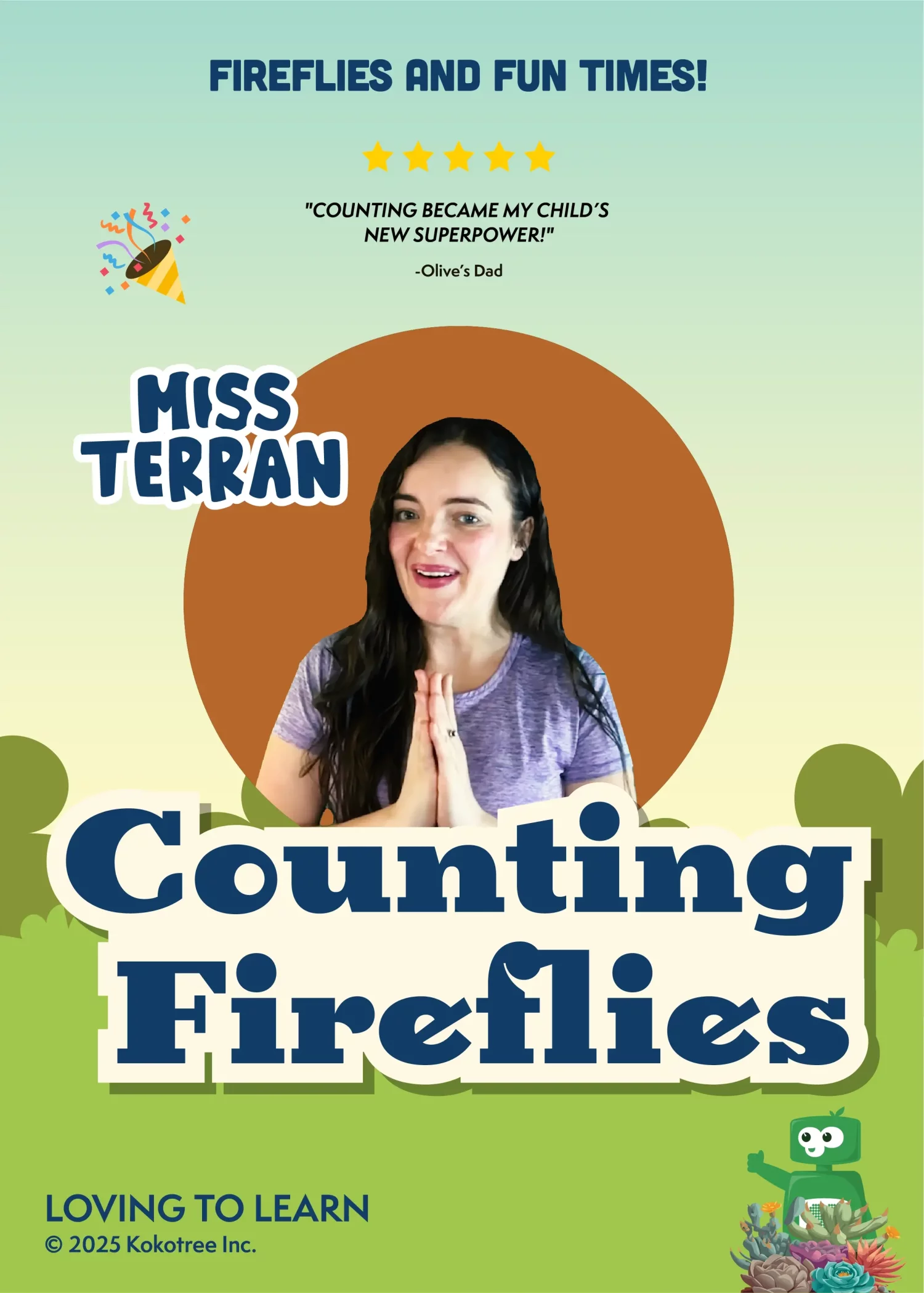
What's Counting Fireflies About?
Watch magical fireflies light up the night sky while your little one masters counting from 1 to 10—and back down again! Through a catchy, repeating song, children practice number recognition and get their first taste of subtraction.
4 minutes
Ages 2-5
Skill: Counting forward and backward 1-10
Your kid watches fireflies fly away one by one. You get 4 minutes to finish your coffee.
Miss Taryn introduces 10 glowing fireflies dancing across the screen. As she sings, one firefly flies away at a time while children count down from 10 to zero. The fireflies return at the end for a happy reunion and one final count to 10.
What your child learns:
This video builds number confidence through repetition and rhythm. Children hear each number multiple times, see the quantity change visually, and practice counting along—hitting the learning trifecta of seeing, hearing, and doing.
- Counting 1-10 forward and backward
- Understanding "one less" (early subtraction concept)
- Number sequence recognition
- Connecting spoken numbers to quantities
- Following along with rhythmic patterns
They'll use these skills when:
- Counting out crackers at snack time ("You have 5, give one to your sister, now you have...")
- Climbing stairs and counting each step up or down
- Playing hide-and-seek and counting to 10
- Sharing toys with friends ("I have 4 blocks, here's one for you")
The Story (what keeps them watching)
Miss Taryn spots 10 fireflies glowing in the night and invites kids to count them together. Then the fun begins—she teaches a catchy song where one firefly flies away each verse while Mama Firefly calls them back. Kids watch the number shrink from 10 all the way down to zero, singing along as each little light disappears. Just when it seems like all the fireflies are gone... they come back! The video ends with a triumphant count back up to 10 and lots of celebration for a job well done.
How We Teach It (the clever part)
- First 1 minute: Miss Taryn builds excitement, introduces the fireflies, and counts 1-10 together to establish the baseline.
- Minutes 1-3: The countdown song repeats the same structure 10 times, each verse removing one firefly. Repetition + music = memory magic.
- Final minute: Fireflies return, reinforcing that numbers go both ways. Final count to 10 celebrates mastery.
Teaching trick: The song uses the exact same melody and words for each verse, only changing the number. This predictable pattern lets kids anticipate what comes next and join in confidently—even on first watch.
After Watching: Quick Wins to Reinforce Learning
- Mealtime activity: "Let's count your grapes! Now eat one. How many are left?" (Practices "one less" with real objects they can touch and eat)
- Car/travel activity: "I spy 3 red cars. Oh, one drove away! How many now?" (Turns any car ride into subtraction practice)
- Bedtime activity: "Let's count down from 10 like the fireflies. When we get to zero, it's time to close our eyes." (Creates a calming routine while reinforcing backward counting)
- Anytime activity: Hold up fingers and fold one down at a time while singing "One flew away!" (Kinesthetic counting they can do anywhere, anytime)
When Kids Get Stuck. And How to Help.
- "My child can count up but gets confused counting backward." - Totally normal! Backward counting develops later. Start with just 5-1 and use fingers or objects so they can SEE the quantity shrinking.
- "They just watch but won't count along." - Listening IS learning at this age. After a few watches, pause the video and let them fill in the next number. They'll surprise you.
- "The numbers in the middle (6, 7, 8) always trip them up." - These are the trickiest for everyone! Practice counting objects around the house in that range specifically—count 7 spoons, find 8 leaves.
What Your Child Will Learn
Prerequisites and Building Blocks
Children benefit most from this video if they have basic exposure to numbers 1-5 and can recognize that counting relates to quantity. This video builds on foundational number awareness and prepares children for formal subtraction concepts. It pairs perfectly with other Kokotree counting videos and serves as a bridge between rote counting and mathematical operations. The repetitive song structure scaffolds learning for children at various stages of number mastery.
Cognitive Development and Teaching Methodology
The teaching approach leverages several developmental principles ideal for ages 2-5. Musical repetition activates memory encoding, while the countdown structure introduces one-to-one correspondence and cardinality. Visual learners see fireflies disappear, auditory learners hear the changing numbers, and kinesthetic learners can hold up fingers along with the song. The predictable pattern reduces cognitive load, allowing children to focus on number concepts rather than following a complex storyline.
Alignment with Educational Standards
This video addresses Common Core Math Standard K.CC.A.1 (count to 100 by ones) and K.CC.A.2 (count forward from a given number). It also introduces K.OA.A.1 (represent subtraction). Most kindergarten readiness assessments expect children to count to 10 and understand that removing one object changes the total. This video builds exactly those benchmarks through age-appropriate, engaging practice that teachers rely on as foundational skills.
Extended Learning Opportunities
Extend learning with printable firefly counting worksheets where children cross off one firefly per verse. The Kokotree app offers interactive counting games that reinforce these skills with touch-based activities. Parents can create a simple firefly craft using paper circles and have children act out the song. Glow sticks in a dark room make an exciting tactile counting experience that brings the video to life beyond the screen.
Transcript Highlights
- "Let's count them together. 1, 2, 3, 4, 5, 6, 7, 8, 9, 10." — Models counting with clear pacing
- "One flew away... Now we only have nine." — Explicitly states the subtraction result
- "Now we only have none." — Introduces zero as a quantity concept
- "You are amazing at counting... Let's count 1 to 10 one more time together before we go." — Celebrates effort and reinforces learning through final practice
Character Development and Story Arc
Miss Taryn models enthusiasm for learning and genuine pride in children's efforts. She asks questions ("What is your name?") to create connection and pauses for responses, teaching children that learning is interactive. The Mama Firefly character in the song demonstrates gentle persistence—she keeps calling the fireflies back, modeling patience. The fireflies' return at the end shows that even when things seem gone, they can come back—a reassuring message paired with mathematical closure.
Mathematical Foundations: Understanding Subtraction Through Countdown Songs
Countdown songs are one of the most effective tools for introducing subtraction to young children because they make an abstract concept concrete and predictable. When children sing "10 little fireflies... one flew away... now we only have 9," they're experiencing the mathematical operation of subtraction (10 - 1 = 9) without formal notation.
This approach works because it leverages several mathematical principles. First, it demonstrates the "counting back" strategy—one of the earliest mental math techniques children develop. Second, it reinforces cardinality (the last number counted represents the total quantity). Third, it introduces the concept of zero as a meaningful number, not just "nothing."
The repetitive structure is intentional. Research shows children need 10-15 exposures to a concept before it moves into long-term memory. This single video provides 10 subtraction examples, each following identical language patterns. This consistency allows children to predict outcomes ("If we have 6 and one flies away, we'll have...") which is the foundation of mathematical reasoning.
The return of the fireflies at the end isn't just a happy ending—it subtly introduces the inverse relationship between addition and subtraction. What was taken away can be added back. This conceptual understanding typically develops around age 5-6, but early exposure through story creates neural pathways that make formal math instruction easier later.
For parents, the key takeaway is that "playing" with numbers through songs builds the same skills as worksheet drills—but with joy attached. Children who associate math with positive emotions show stronger math performance throughout elementary school.