
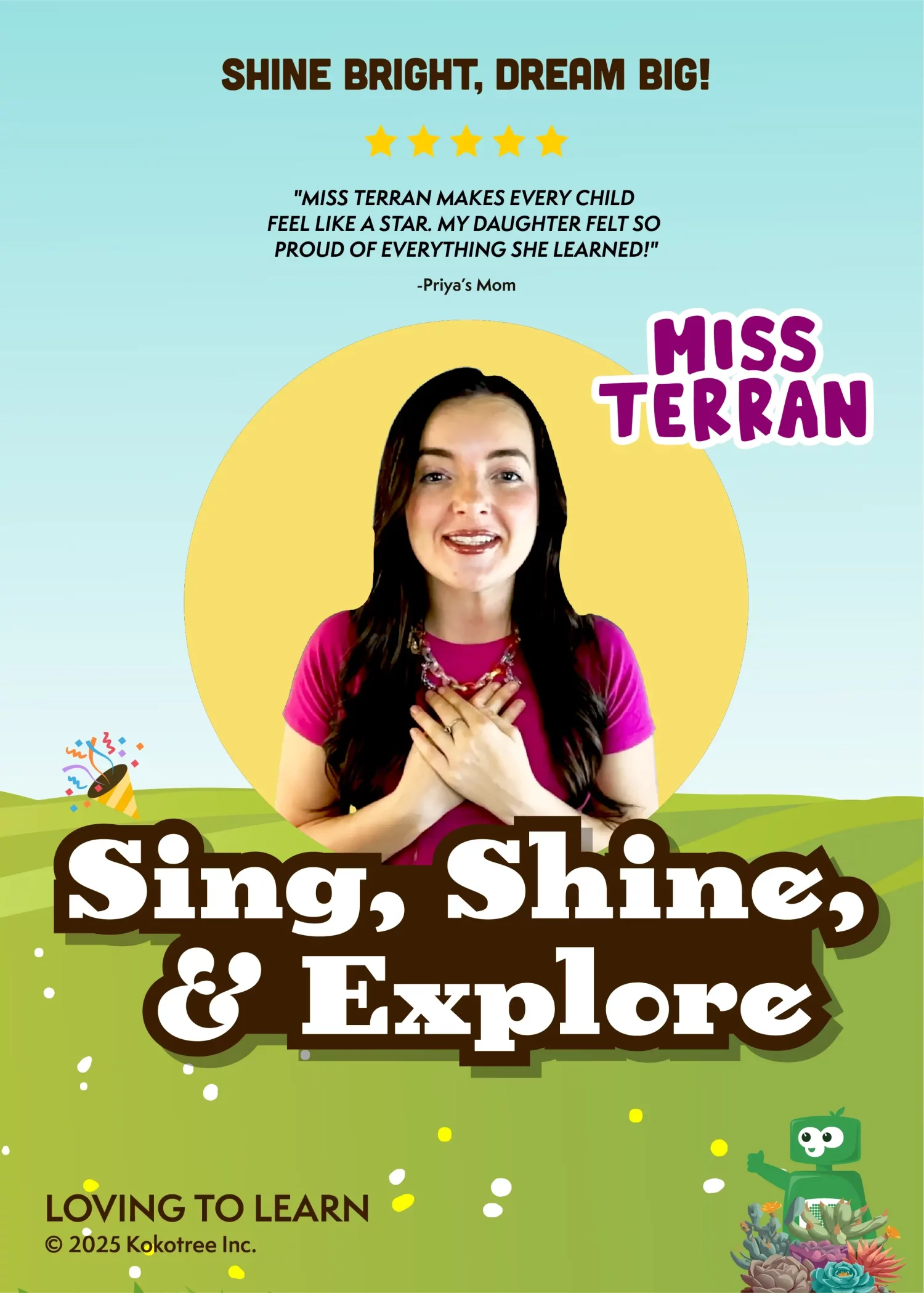
What's Sing, Shine, & Explore About?
Your little one embarks on a sky-high adventure learning about day and night while singing, moving, and meeting farm animal friends! After watching, they'll confidently point out the sun during the day and spot the moon and stars at bedtime.
4.5 minutes
Ages 1-6
Skill: Understanding day vs. night and basic science concepts
Your kid watches the sun set and stars appear on screen. You get 4.5 minutes to finish that cup of coffee.
Ms. Taryn guides little explorers through a colorful journey from bright daytime skies to peaceful nighttime scenes. Children see the warm sun, blue skies, and chirping birds transform into a glowing moon surrounded by twinkling stars. The adventure continues to a lively farm where friendly animals make their signature sounds.
What your child learns:
This video introduces foundational science concepts about Earth's day and night cycle in terms toddlers can grasp. Children also build vocabulary, practice listening skills, and connect animal names to their sounds.
- Identifying the sun, moon, and stars in the sky
- Understanding that daytime and nighttime are different
- Recognizing farm animal sounds (cow, pig, duck, sheep, horse, bee, mouse, frog, owl)
- Following movement instructions (flapping, stopping on cue)
- Singing along to familiar melodies like "Twinkle, Twinkle, Little Star"
They'll use these skills when:
- Looking out the window and describing whether it's day or night
- Pointing at the moon during an evening walk and saying "moon!"
- Visiting a farm, zoo, or petting area and naming animals by their sounds
- Following simple instructions during playtime or storytime
The Story (what keeps them watching)
Ms. Taryn invites little explorers on a magical sky adventure! First, they meet the bright, warm sun and practice flapping like birds under the blue daytime sky. Then—whoosh—the sun goes down and the moon appears with twinkling stars. A curious Baby Owl wonders what those sparkly lights are, so everyone sings "Twinkle, Twinkle, Little Star" together to help him understand. After a quick review of day vs. night, the adventure shifts to a lively farm where children meet cows, pigs, ducks, and more—learning each animal's special sound through an upbeat song!
How We Teach It (the clever part)
First 2 minutes: Ms. Taryn introduces the sun and daytime concepts with vocabulary practice ("Can you say sun?") and movement breaks (flapping like birds). Children connect the sun to warmth, light, and outdoor play.
Minutes 2-3: The transition to nighttime introduces the moon and stars. Baby Owl's curiosity creates a relatable moment, and singing "Twinkle, Twinkle, Little Star" reinforces vocabulary through music and repetition.
Final 1.5 minutes: A quick day/night review locks in learning, then a farm animal song adds variety while building vocabulary and encouraging movement.
Teaching trick: The video uses call-and-response prompts ("Can you say moon?") that give children time to verbally participate, turning passive watching into active learning.
After Watching: Quick Wins to Reinforce Learning
Mealtime activity: "Is it daytime or nighttime right now? How do you know?" (Reinforces observation skills and day/night vocabulary—look out the window together for clues!)
Car/travel activity: "Let's play the animal sound game! I'll name an animal, you make the sound. Ready? Cow!" (Practices recall and builds confidence with animal vocabulary from the video.)
Bedtime activity: "Look outside—can you find the moon? What about stars?" (Connects video learning to real-world observation and makes bedtime routines feel magical.)
Anytime activity: "Let's flap like birds! Flap, flap, flap... STOP!" (Practices following instructions and body control while burning energy—works anywhere, anytime.)
When Kids Get Stuck. And How to Help.
"My child can't tell the difference between day and night yet." - Totally normal for this age! Keep it simple: "Sun means daytime, moon means nighttime." Point these out in real life over the next few days and it'll click.
"They mix up animal sounds or can't remember them all." - Nine animals is a lot! Focus on 2-3 favorites first (cow, duck, and pig are usually hits). Rewatch the farm song section and pause to practice each one.
"My toddler won't say the words back when prompted." - Many children prefer to listen and absorb before speaking. They're still learning! Keep modeling the words yourself, and one day they'll surprise you with "MOON!" at bedtime.
What Your Child Will Learn
Prerequisites and Building Blocks
This video works beautifully as an introduction to basic science concepts—no prior knowledge needed! Children benefit from basic vocabulary exposure (sky, light, sleep) but the video teaches key terms from scratch. It builds on natural curiosity about the world and pairs well with videos about colors (the blue sky), weather, and animals. This foundational understanding of day and night prepares children for more complex concepts like seasons, weather patterns, and Earth science in later learning stages.
Cognitive Development and Teaching Methodology
The teaching approach leverages multi-sensory learning perfectly suited for ages 1-6. Visual learners see the sun, moon, and stars on screen. Auditory learners hear vocabulary repeated and reinforced through songs. Kinesthetic learners engage through movement breaks (flapping, hopping). The call-and-response format ("Can you say sun?") activates verbal processing, while the pause-and-wait technique gives developing brains time to formulate responses—essential for toddlers whose processing speed is still developing.
Alignment with Educational Standards
This video addresses multiple kindergarten readiness indicators including science observation skills (noticing environmental changes), vocabulary development, and following multi-step directions. It aligns with early learning standards for understanding basic Earth science concepts and natural phenomena. The animal sound segment supports language development benchmarks for onomatopoeia recognition. Movement activities address gross motor skill expectations for preschool-age children.
Extended Learning Opportunities
Pair this video with Kokotree's color recognition activities (focus on blue and yellow), animal identification games, and music-based learning modules. Create a simple day/night sorting activity using magazine pictures. Draw the sun on yellow paper and the moon on white paper for a bedroom decoration. During evening routines, start a "moon journal" where children draw what the moon looks like each night—building observation skills and creating a special bonding ritual.
Transcript Highlights
- Vocabulary introduction: "Look up, it's the sun. The sun gives us light and keeps us warm. Can you say sun? Sun, sun."
- Movement instruction: "Let's flap our wings like a bird. Flap, flap, flap, again. Flap, flap, flap. Stop. Did you stop? Good job."
- Concept reinforcement: "Daytime brings sun, blue sky, birds singing and playing outside. Nighttime brings the moon, stars, twinkling lights and bedtime."
- Encouraging participation: "Let's sing a special song together and help him understand."
Character Development and Story Arc
Ms. Taryn models enthusiastic, patient teaching throughout—celebrating every response with "Good job!" and "Great work!" Baby Owl demonstrates healthy curiosity by wondering about the twinkling stars, showing children that asking questions is wonderful. The video reinforces a growth mindset through phrases like "Learning is such a wonderful gift" and "Be proud of who you are." Children see that not knowing something (like Baby Owl) leads to discovery, not frustration.
Understanding Day and Night: A STEAM Deep Dive
The concept of day and night represents one of children's earliest encounters with Earth science and astronomy—making it a perfect entry point for STEAM learning. At its core, this video teaches observational science: children learn to notice environmental changes (light vs. dark, sun vs. moon) and connect them to daily routines (playing outside vs. bedtime).
For young children, understanding day and night begins with direct sensory experience. The sun feels warm and makes things bright; nighttime feels different and looks different. This video builds on those innate observations by giving children vocabulary to describe what they already notice. The progression from concrete ("the sun gives us light") to slightly abstract ("the stars twinkle while we sleep") scaffolds understanding appropriately.
The inclusion of "Twinkle, Twinkle, Little Star" isn't just entertaining—it's pedagogically strategic. Music activates multiple brain regions simultaneously, strengthening memory formation. The lyrics reinforce vocabulary (star, sky, diamond, twinkle) while the familiar melody provides comfort and encourages participation from even the shyest learners.
The farm animal segment might seem unrelated, but it serves an important cognitive purpose: variety prevents fatigue and helps consolidate earlier learning. By shifting focus, children's brains have time to process the day/night concepts while staying engaged. The animal sounds also build phonemic awareness—a critical pre-reading skill—through playful imitation.
This foundational understanding prepares children for future concepts including seasons, weather, animal habitats (nocturnal vs. diurnal animals), and eventually, Earth's rotation and the solar system.