
What's Five Little Speckled Frogs About?
Sing along as playful frogs hop off a log one by one, teaching your child to count backwards from 5 to 0! After watching, they'll understand subtraction basics and confidently count down in everyday situations.
3 minutes
Ages 1-6
Skill: Counting backwards and early subtraction
Your kid watches frogs splash into a pool one by one. You get 3 minutes to finish your coffee.
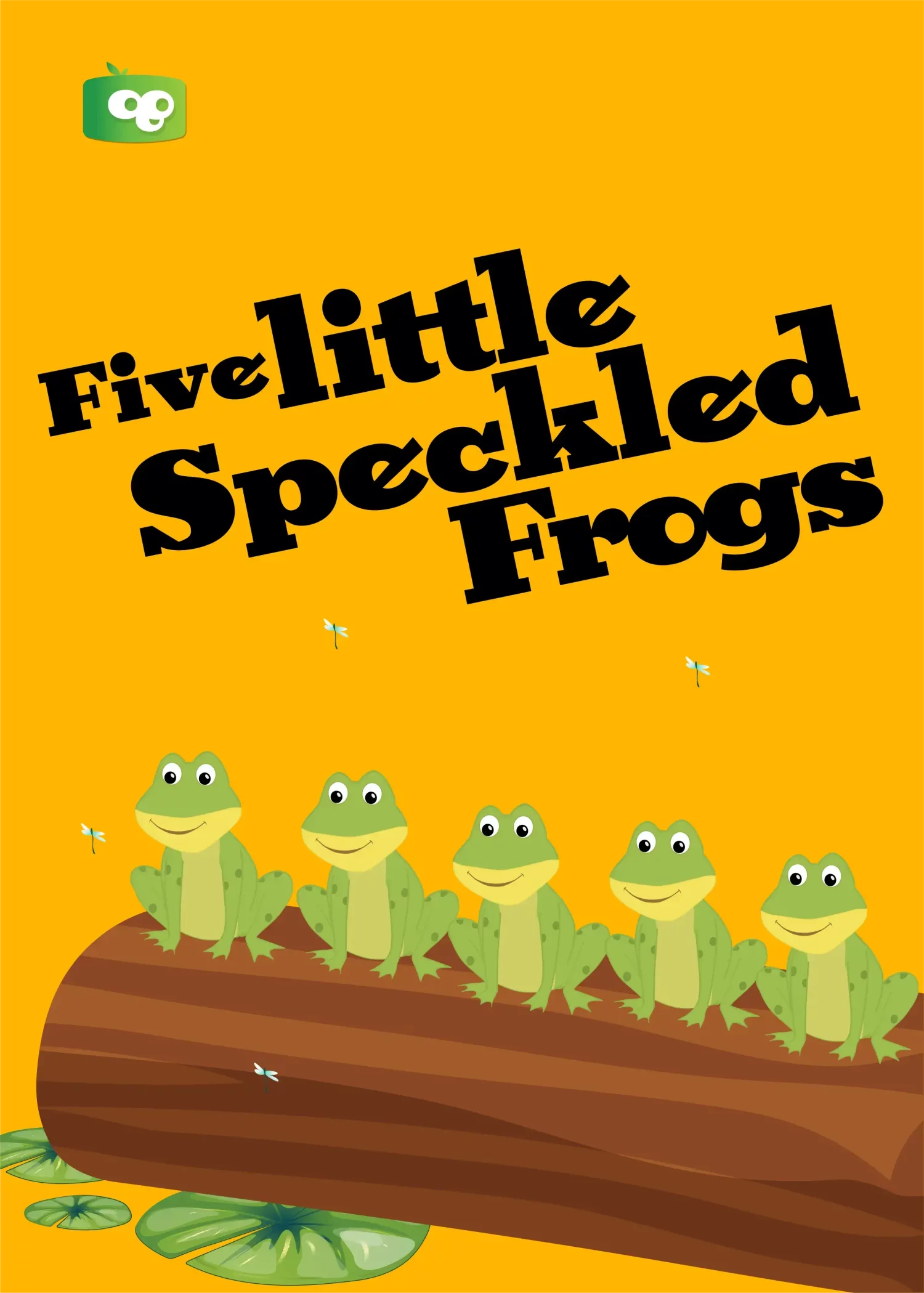
Five adorable speckled frogs sit on a log munching bugs. One by one, each frog jumps into the cool pool below with a satisfying "Glug! Glug!" The catchy, repetitive song counts down from five frogs to four, then three, two, one—until no frogs remain on the log.
What your child learns:
This classic counting song introduces subtraction through a simple, visual story. Each verse removes one frog, helping children see what "one less" actually looks like. The repetition builds number confidence while the fun sound effects keep little ones engaged.
- Counting backwards from 5 to 0
- Understanding "one less" as a subtraction concept
- Number recognition and sequence
- Predicting what comes next in a pattern
- Connecting numbers to real quantities (5 frogs, 4 frogs, etc.)
They'll use these skills when:
- Counting down the grapes left on their plate at snack time
- Waiting for a timer ("3... 2... 1... go!")
- Sharing toys and figuring out how many are left
- Playing hide-and-seek and counting backwards from 10
The Story (what keeps them watching)
Five cheerful speckled frogs are having the best day—sitting on their favorite log, enjoying a bug buffet in the sunshine. But that pool looks SO refreshing! One brave frog can't resist and leaps in with a splash. Now there are four. The remaining frogs keep munching, but one by one, they each take the plunge. Kids watch eagerly to see who jumps next, counting along until—splash!—the last frog joins the pool party. The repeated "Yum! Yum!" and "Glug! Glug!" sounds make this irresistibly singable.
How We Teach It (the clever part)
First minute: Introduces all five frogs on the log, establishing the starting number. The catchy melody and "Yum! Yum!" sounds capture attention while kids absorb the visual of five frogs together.
Minutes 1-2: The countdown begins! Each verse removes one frog, with clear pauses between numbers. Kids hear "then there were four," "then there were three"—connecting spoken numbers to the visual change on screen.
Final minute: The song reaches zero frogs on the log, completing the countdown. The repeated "Glug! Glug!" at the end celebrates the learning while reinforcing that zero means "none left."
Teaching trick: The song pauses briefly after each frog jumps, giving children time to process the new number before it's spoken. This "wait time" helps little brains make the connection between seeing one less frog and hearing the next number down.
After Watching: Quick Wins to Reinforce Learning
Mealtime activity: "You have five crackers! Eat one—how many now?" Count down snacks together as your child eats them, turning snack time into subtraction practice without any extra effort.
Car/travel activity: "Let's count backwards from 5 like the frogs! 5... 4... 3... 2... 1... GLUG!" Practice the countdown sequence anywhere, adding the silly splash sound to keep it fun.
Bedtime activity: "Hold up five fingers. One frog jumped in the pool—put one finger down. How many fingers now?" Use fingers as frogs to make the subtraction physical and visual.
Anytime activity: Line up five toys on the couch (the "log"). Have your child make one "jump off" at a time while counting how many remain. Ask, "How many are left on the log now?"
When Kids Get Stuck. And How to Help.
"My child just sings along but doesn't seem to understand the counting." - That's actually perfect for now! Musical memory comes first, and number understanding follows. Keep singing together, and try holding up fingers to match the frogs—the physical connection helps the math click.
"She can count forward but gets confused going backwards." - Backward counting is genuinely harder for young brains. Start smaller: practice counting back from 3 first. Use the frog song's structure but with just three toys, then build up to five.
"He doesn't understand that zero means none left." - Zero is an abstract concept! Make it concrete by playing the frog game with real objects. When the last one "jumps," show your empty hands dramatically: "Zero frogs! None left! They're all in the pool!"
What Your Child Will Learn
Prerequisites and Building Blocks
Children benefit most from this video if they can already count forward from 1 to 5 and recognize those numerals. This song builds on basic counting skills introduced in number recognition videos and prepares children for formal subtraction. It bridges the gap between rote counting and understanding quantity—a crucial step before kindergarten math. The repetitive structure supports children still mastering forward counting while challenging those ready for backwards sequences.
Cognitive Development and Teaching Methodology
Repetitive songs with predictable patterns work beautifully for ages 1-6 because young brains thrive on anticipation and confirmation. This video uses multi-sensory learning: children hear the countdown (auditory), see frogs disappear (visual), and can act out jumping motions (kinesthetic). The consistent verse structure reduces cognitive load, letting children focus on the changing number rather than processing new information each time.
Alignment with Educational Standards
This video supports Common Core Math Standard K.CC.A.1 (count to 100 by ones) and K.OA.A.1 (represent subtraction). It addresses kindergarten readiness indicators for number sense and one-to-one correspondence. Early childhood educators expect entering kindergartners to count backwards from at least 10 and understand that removing objects decreases quantity—both skills this song directly practices through engaging repetition.
Extended Learning Opportunities
Pair this video with printable frog counting worksheets featuring five lily pads. The Kokotree app includes interactive counting games where children tap to remove objects and see the number change. Extend learning with bathtub play using toy frogs, pond-themed sensory bins with numbered logs, or drawing five frogs and crossing them off one by one while singing.
Transcript Highlights
- "Five little speckled frogs sat on a speckled log" — Establishes the starting quantity with clear, countable language
- "One jumped into the pool" — Explicitly states the subtraction action (removing one)
- "Then there were four green speckled frogs" — Immediately names the result, connecting action to new quantity
- "Then there were no green speckled frogs" — Introduces zero as a valid number representing "none left"
Character Development and Story Arc
The five speckled frogs model joyful, curious behavior—they're happily enjoying their log and bugs before discovering something even better (the cool pool). Each frog demonstrates the courage to try something new by jumping in. The frogs don't show fear or hesitation; they simply explore their environment. This gentle narrative arc—contentment, discovery, action—mirrors how young children approach learning: finding something interesting and diving in.
Mathematical Foundations: Counting Backwards and Early Subtraction
Backward counting is significantly more cognitively demanding than forward counting because it requires children to reverse a learned sequence while maintaining number sense. This video introduces subtraction conceptually before children encounter formal notation (5-1=4). Research in early mathematics education shows that understanding "one less" through concrete examples—like frogs leaving a log—builds the mental number line children need for later arithmetic.
The song uses what educators call "count-down subtraction," where children see a quantity decrease and must determine the result. This differs from "count-up addition" and requires different mental processes. By watching five frogs become four, children develop cardinality understanding—knowing that the last number counted represents the total quantity.
The progression to zero is particularly valuable. Zero is abstract and often confusing for young children because it represents the absence of quantity. By showing an empty log and stating "no green speckled frogs," the video makes zero concrete and meaningful. Children learn that zero isn't "nothing"—it's a real number that tells us how many remain.
The repetitive structure also supports working memory development. Children must hold the current number in mind, process the subtraction of one, and predict the next number—all skills that strengthen mathematical thinking and prepare children for more complex problem-solving in elementary school.