
What's Hickory Dickory Dock About?
Your child joins a curious mouse on a counting adventure up a grandfather clock, learning numbers 1-12 through catchy rhymes and repetition. After watching, they'll confidently count to twelve and start noticing numbers on clocks everywhere!
2 minutes
Ages 1-6
Skill: Counting 1-12 and number recognition
Your kid watches a mouse climb a clock and count to twelve. You get 2 minutes to drink your coffee while it's still warm.
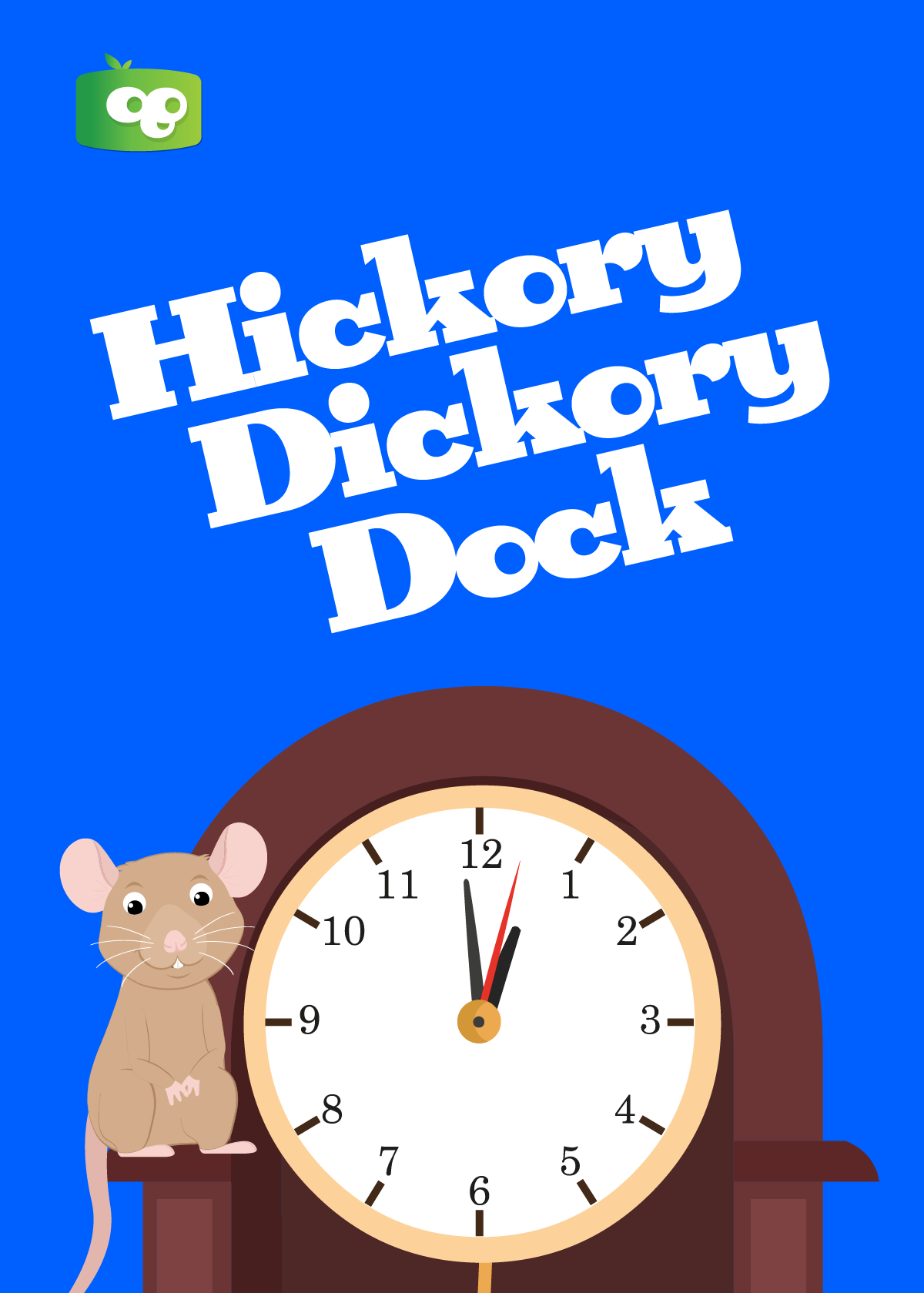
A friendly mouse scampers up a tall clock while cheerful music plays. Each time the clock strikes a new hour, your child sees and hears the number—building from one all the way to twelve. The repetitive "Hickory dickory dock" chorus keeps little ones engaged while numbers appear on screen.
What your child learns:
This classic nursery rhyme transforms counting practice into an irresistible game. The predictable pattern helps children anticipate what comes next, building number sequence confidence through musical repetition.
- Counting from 1 to 12 in sequence
- Recognizing numbers on a clock face
- Understanding rhythm and rhyming patterns
- Building memory through repetition
- Connecting numbers to real objects (clock hands)
They'll use these skills when:
- Counting snacks at the table ("You get five crackers!")
- Looking at clocks and asking "What time is it?"
- Counting steps while climbing stairs together
- Playing hide-and-seek and counting to ten (or twelve!)
The Story (what keeps them watching)
A brave little mouse has a mission: climb that big grandfather clock! Each verse, the clock strikes a new hour, and our mouse friend reacts in silly ways—flying down at two, fleeing at three, hitting the floor at four. The tension builds as numbers climb higher until the clock strikes all the way to twelve with a dramatic "springing" finale. The final verse gives a sweet twist: the mouse admits the loud clock scares him! It's silly, rhythmic, and keeps tiny viewers guessing what the mouse will do next.
How We Teach It (the clever part)
- First 30 seconds: The familiar "Hickory dickory dock" melody introduces the mouse and clock, establishing the pattern with numbers one and two.
- Minutes 0:30-1:30: Numbers build progressively from three through eleven, with each verse adding a new number while maintaining the catchy rhythm that helps kids remember the sequence.
- Final 30 seconds: The song reaches twelve with dramatic flair, then closes with a gentle conclusion that reinforces the full counting journey.
Teaching trick: Each number gets its own verse with a unique rhyming action ("struck three, did he flee?"), creating memorable mental hooks that help children associate numbers with fun imagery.
After Watching: Quick Wins to Reinforce Learning
- Mealtime activity: "Let's count your peas like the mouse counts clock chimes!" Point to each item while counting together. (Practices one-to-one correspondence)
- Car/travel activity: "Can you find any clocks? What numbers do you see?" Look for clocks in stores, on buildings, or on phones. (Reinforces number recognition in real contexts)
- Bedtime activity: "Let's count to twelve like the clock—what time do you think the mouse goes to sleep?" Count together slowly while snuggling. (Connects counting to calming routines)
- Anytime activity: "Run up the stairs like the mouse runs up the clock! Let's count each step." Count stairs, sidewalk squares, or toy blocks together. (Adds movement to counting practice)
When Kids Get Stuck. And How to Help.
- "My child always skips certain numbers when counting." - Totally normal! Numbers like 7 and 11 are tricky. Sing the song together slowly, pausing to emphasize the numbers they skip. Repetition through music builds the sequence naturally.
- "She can sing along but doesn't seem to understand what the numbers mean." - Singing is the first step! Understanding quantity comes next. Try holding up fingers as you sing each number together to connect the sound to something concrete.
- "He loses interest before the song ends." - Two minutes is actually quite long for little ones! Celebrate however much they watch. You can also pause and ask "What number comes next?" to boost engagement.
What Your Child Will Learn
Prerequisites and Building Blocks
This video works beautifully for children just beginning their number journey—no prior counting skills required! It builds on basic listening skills and familiarity with music and rhythm. "Hickory Dickory Dock" serves as an excellent foundation for later clock-reading skills and understanding time concepts. Children who've watched other Kokotree counting videos will recognize the sequential number pattern, while newcomers will quickly catch on through the repetitive structure.
Cognitive Development and Teaching Methodology
The teaching approach leverages several developmental principles perfect for ages 1-6. Repetition with variation keeps the brain engaged while building neural pathways for number sequences. The musical delivery activates auditory learning channels, while the visual mouse-and-clock imagery supports visual learners. Kinesthetic learners benefit from the implied movement (running up, flying down) that invites physical mimicry. The predictable pattern reduces cognitive load, letting children focus on the numbers themselves.
Alignment with Educational Standards
This video supports Common Core Kindergarten standard K.CC.A.1 (count to 100 by ones) by building the foundational 1-12 sequence. It aligns with Head Start Early Learning Outcomes for mathematics, specifically "Child knows number names and the count sequence." Preschool teachers expect children entering kindergarten to count to at least 10—this video extends that to 12, giving children a confidence boost and introduction to the numbers on a clock face.
Extended Learning Opportunities
Pair this video with printable clock face worksheets where children can place number stickers in order. The Kokotree app's number tracing games reinforce numeral formation for the numbers featured. Consider following up with other counting songs in the Little Seeds program to practice the same sequence in different contexts. Simple paper plate clock crafts extend learning offline—let children move the hands while counting aloud.
Transcript Highlights
- "The clock struck one, the mouse ran down" - Introduces the counting pattern with the simplest number
- "The clock struck seven, eight, nine, ten, eleven" - Demonstrates rapid sequential counting, challenging children to keep up
- "As twelve bells rang, the mouse he sprang" - Celebrates reaching the final number with dramatic language
- "Why scamper at the clock? You scare me so" - Models emotional vocabulary while providing narrative closure
Character Development and Story Arc
The mouse character demonstrates persistence and curiosity—core learning behaviors for young children. Despite being startled each time the clock chimes, the mouse keeps climbing back up, modeling the "try again" mindset essential for early learning. The final verse shows emotional awareness as the mouse admits feeling scared, demonstrating that it's okay to acknowledge feelings. This gentle character arc shows children that learning sometimes feels challenging, but we keep exploring anyway.
Number Sense and Early Mathematical Thinking Deep Dive
Counting to twelve represents a crucial milestone in early mathematical development. Unlike counting to ten, which children often memorize as a single "chunk," counting to twelve requires understanding that numbers continue in a predictable pattern beyond familiar territory. This video strategically builds number sense through several mathematical principles.
The one-to-one correspondence between clock chimes and numbers helps children understand that each number represents a specific quantity—one chime means one, two chimes means two. This cardinality concept forms the foundation for all future mathematical thinking.
The clock context introduces children to a real-world number application they'll encounter daily. Clock faces present numbers in a circular arrangement rather than a line, which expands spatial understanding of number relationships. Children begin recognizing that "12" isn't just "after 11" but also represents a complete cycle—early exposure to cyclical patterns that become important in telling time.
The rhythmic delivery supports what researchers call "verbal counting"—the ability to recite numbers in order. This differs from "object counting" but serves as a necessary prerequisite. Children typically master verbal counting first, then apply it to counting actual objects. The song's predictable rhythm creates a "counting melody" that children can recall independently, making practice feel like play rather than work.
Sequential counting also builds pattern recognition skills. Children begin anticipating "what comes next," which develops logical thinking and prediction abilities that transfer to reading readiness and scientific inquiry.