
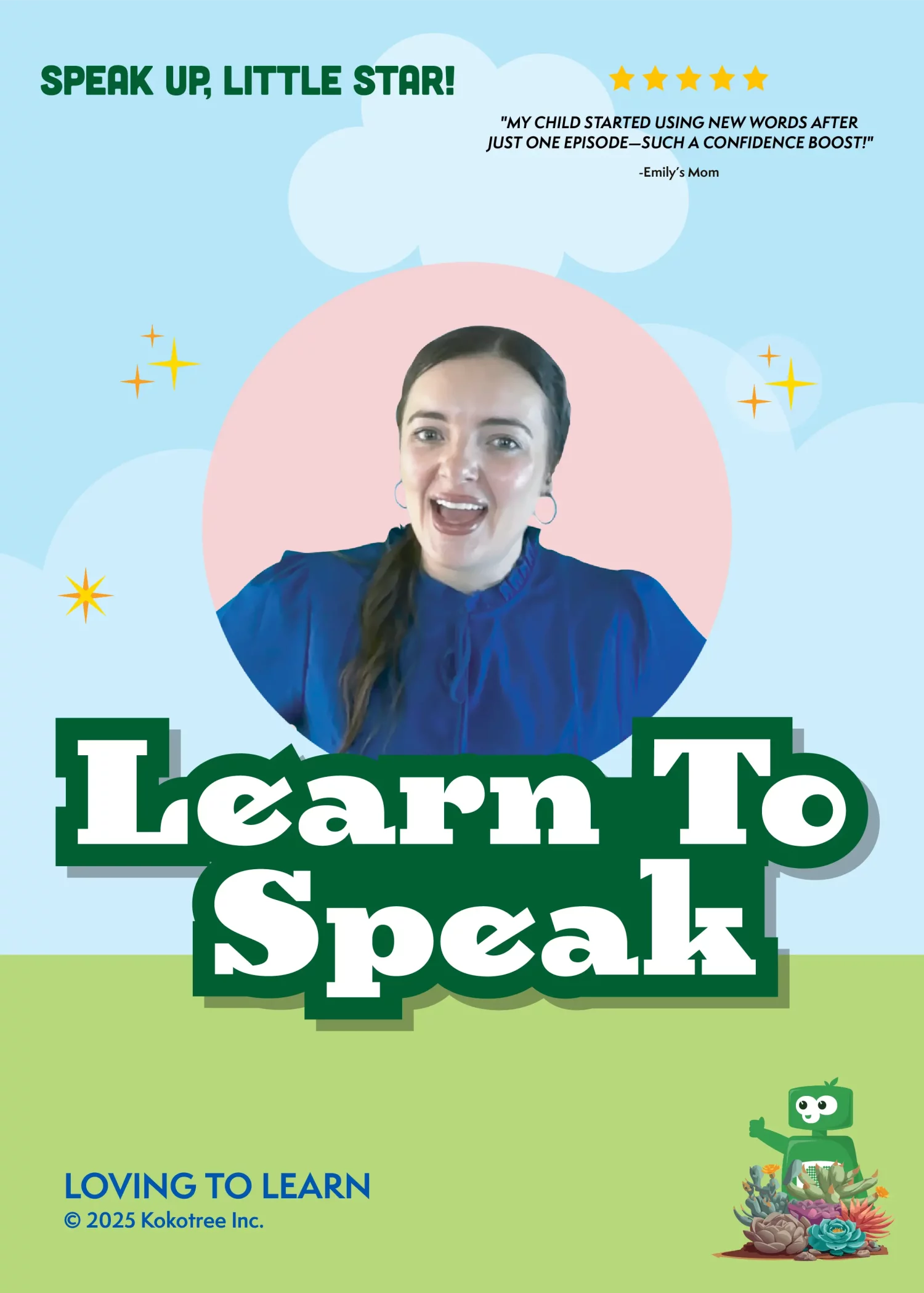
What's Learn to Speak About?
Your little one will practice letter sounds, build vocabulary, and discover the magic of nighttime—all while singing along to a beloved classic! After watching, they'll be pointing at the sky saying "moon" and "stars" like tiny astronomers.
4 minutes
Ages 1-4
Skill: Letter sounds and early vocabulary
Your kid watches letters come alive with fun sounds and songs. You get 4 minutes to finish that cup of coffee.
Miss Taryn introduces letters D through G with cheerful repetition and relatable images—dogs, eggs, flowers, and grapes. Then the scene shifts to a peaceful nighttime sky where baby owl discovers twinkling stars, leading into an interactive sing-along of "Twinkle, Twinkle, Little Star."
What your child learns:
This video builds phonemic awareness by connecting letter sounds to familiar objects. Children also expand their vocabulary with nature words and practice the social skill of singing along.
- Recognizes letters D, E, F, and G by sight and sound
- Connects beginning sounds to objects (D-D-D, dog)
- Identifies moon and stars in the night sky
- Builds vocabulary: grandma, grandpa, moon, stars, night
- Practices singing and rhythm through a classic nursery rhyme
They'll use these skills when:
- Pointing at letters on cereal boxes during breakfast
- Looking up at the sky and naming what they see at bedtime
- Recognizing the letter their name starts with
- Singing songs at playgroup or with caregivers
The Story (what keeps them watching)
Miss Taryn takes little learners on a letter adventure, starting with D for dog and moving through E, F, and G with tasty eggs, sweet-smelling flowers, and yummy grapes. But then—surprise!—the sun goes down and the sky transforms into a sparkling nighttime scene. Baby owl appears, curious about those twinkling lights above. Together, everyone sings "Twinkle, Twinkle, Little Star" to help baby owl understand the magic of stars. It's cozy, calming, and perfect for winding down while still learning.
How We Teach It (the clever part)
- First 1.5 minutes: Letters D through G are introduced with clear pronunciation, repetition, and visual associations (dog, egg, flower, grapes). Each letter gets its own moment to shine.
- Minutes 1.5-2.5: Vocabulary expands with "grandma" and "grandpa," then transitions to nighttime concepts—moon and stars—with gentle prompts for children to repeat.
- Final 1.5 minutes: Learning is reinforced through song! "Twinkle, Twinkle, Little Star" brings rhythm and repetition, cementing vocabulary while celebrating the child's participation.
Teaching trick: Miss Taryn uses the "triple repeat" method ("D-D-D, dog") which helps toddlers connect the letter sound to the word through auditory repetition—exactly how young brains build phonemic awareness.
After Watching: Quick Wins to Reinforce Learning
- Mealtime activity: "Can you find something that starts with G on your plate?" Point to grapes, green beans, or even the glass. Practice that G-G-G sound together!
- Car/travel activity: "Let's look for the letter D on signs!" Spot D's on street signs, buildings, or license plates. Celebrate every find with a "D-D-D, dog!"
- Bedtime activity: "Can you see the moon tonight?" Before tucking in, peek out the window together. Say "moon" and "stars" and hum a bit of "Twinkle, Twinkle."
- Anytime activity: "What sound does flower start with?" Pick up any object around the house and practice the beginning sound together. F-F-F, fork! E-E-E, elbow!
When Kids Get Stuck. And How to Help.
"My child just watches but won't repeat the words." Totally normal! Toddlers often absorb before they produce. Keep watching together and model the sounds yourself—they're learning even when quiet. One day they'll surprise you!
"They mix up the letter sounds." Letter sounds are tricky, especially similar ones. Focus on just one letter per day during play. "Today is D day—let's find dogs, doors, and ducks!" Repetition builds confidence.
"The video seems too easy/hard for my child." This video works on multiple levels! Younger toddlers absorb the sounds and visuals, while older preschoolers can practice spelling and identifying letters. Meet them where they are.
What Your Child Will Learn
Prerequisites and Building Blocks
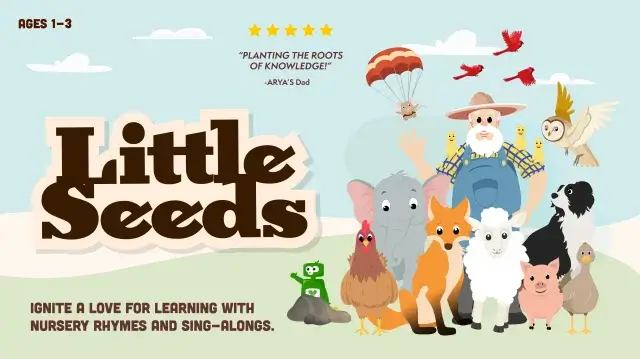
This video is ideal for children who are beginning to show interest in letters and sounds. No prior letter knowledge is required—it's designed as an introduction to phonemic awareness. It builds on basic listening skills and the ability to focus on visual cues. "Learn to Speak" connects to other alphabet videos in the Little Seeds program, creating a progressive foundation for pre-reading skills. Children who've watched earlier letter videos (A-C) will find familiar teaching patterns here.
Cognitive Development and Teaching Methodology
The video employs spaced repetition and multi-sensory engagement—core principles for early childhood learning. Visual learners see the letter and object together; auditory learners hear the repeated sounds; kinesthetic learners are prompted to speak along. The transition from letters to nighttime vocabulary leverages thematic learning, connecting abstract concepts (letters) to concrete experiences (bedtime). The sing-along activates musical memory pathways, which research shows strengthens retention in young children.
Alignment with Educational Standards
This content aligns with early literacy standards including NAEYC's language and literacy goals and Common Core Foundational Skills for Kindergarten (RF.K.1, RF.K.2). Children practice print awareness by recognizing letters, phonological awareness through initial sound identification, and vocabulary development through contextual word learning. These are key kindergarten readiness indicators that teachers assess in early screenings. The video also supports Head Start's Language Development domain.
Extended Learning Opportunities
Pair this video with Kokotree's letter tracing activities for letters D, E, F, and G. Print simple coloring pages featuring dogs, eggs, flowers, and grapes to reinforce letter-object connections. Explore the app's "Night Sky" game to practice moon and star vocabulary. For extended learning, create a "letter hunt" around your home—stick Post-it notes on items that start with each letter. Read bedtime books featuring moons and stars to continue the nighttime theme.
Transcript Highlights
- "D-D-D, dog. D-O-G." — Clear phonemic modeling with spelling reinforcement
- "Mmm, flower smells so good." — Multi-sensory connection to vocabulary
- "Can you say moon? Moon. Moon. Ah, yes." — Call-and-response prompting active participation
- "At night, the moon glows and the stars twinkle while we sleep." — Contextual vocabulary in a complete sentence
Character Development and Story Arc
Miss Taryn models enthusiasm and patience—two essential learning behaviors for young children. Her warm tone and encouraging phrases ("Great job!" "You are amazing!") demonstrate positive reinforcement. Baby owl serves as a learning companion, showing curiosity and wonder—traits children naturally identify with. When baby owl wonders about the twinkling stars, children see that asking questions is celebrated. The resolution through song shows that learning can be joyful and shared.
Phonemic Awareness and Early Literacy Deep Dive
Phonemic awareness—the ability to hear, identify, and manipulate individual sounds in spoken words—is the strongest predictor of early reading success. This video targets initial sound recognition, a foundational phonemic skill. When Miss Taryn emphasizes "D-D-D, dog," she's isolating the phoneme /d/ and connecting it to both the letter symbol and a concrete object.
This triple association (sound + letter + image) creates multiple neural pathways for memory storage. Research from the National Reading Panel confirms that explicit phonemic instruction significantly improves reading outcomes. The video's approach of introducing just four letters (D, E, F, G) prevents cognitive overload while allowing meaningful repetition.
The vocabulary expansion section (moon, stars, grandma, grandpa) builds receptive and expressive language simultaneously. Children hear words in context ("the moon glows") and are prompted to produce them ("Can you say moon?"). This scaffolded approach—modeling, then inviting participation—follows Vygotsky's zone of proximal development.
The inclusion of "Twinkle, Twinkle, Little Star" isn't just for fun. Musical learning activates the brain's auditory cortex and motor regions simultaneously, creating stronger memory traces. The predictable rhyme scheme also introduces children to phonological patterns they'll later recognize in reading. By ending with song, the video ensures children leave with positive emotional associations to letter learning—setting the stage for a lifelong love of literacy.