
What's Tiny Talks About?
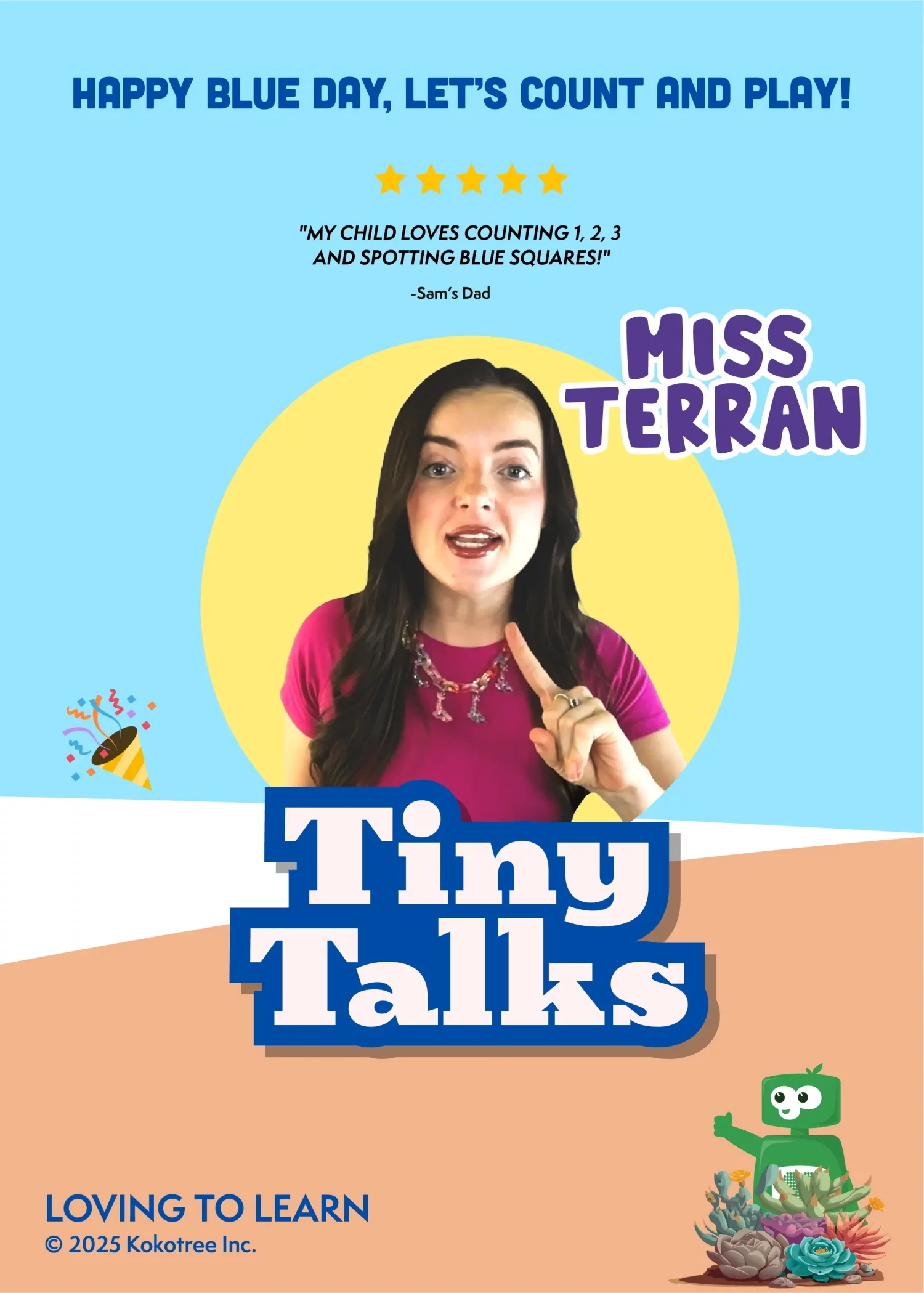
Your little explorer joins Miss Taryn for an interactive learning adventure packed with colors, shapes, and numbers! They'll identify blue objects all around them, spot squares in everyday items, and count to three using their whole body.
5 minutes
Ages 1-4
Skill: Colors, Shapes & Early Counting
Your kid watches Miss Taryn teach colors, shapes, and numbers with movement. You get 5 minutes to drink your coffee while it's still warm.
Miss Taryn guides little ones through a sunny day of discovery, pointing out the blue sky, blue fish, and blue ocean. She introduces squares by asking kids to find things with four corners, then wraps up with counting practice—complete with clapping, stomping, and jumping along with animal friends Eddie the Elephant and Kango the Kangaroo.
What your child learns:
This video builds foundational recognition skills across three key areas. Children learn to identify the color blue in multiple contexts, recognize squares by counting corners, and count from one to three while connecting numbers to physical actions.
- Identifying the color blue in various objects (fish, ocean, hats, sharks)
- Recognizing squares by their four corners
- Counting 1-3 with corresponding movements
- Following multi-step directions (flap, stop, swim)
- Connecting abstract concepts to real-world objects
They'll use these skills when:
- Sorting laundry by color ("Put the blue socks here!")
- Setting the table and counting plates or napkins
- Spotting shapes at the grocery store (cereal boxes are rectangles!)
- Playing with blocks and naming what they build
The Story (what keeps them watching)
Miss Taryn kicks things off by looking up at the sunny sky—perfect for getting little ones curious about the world around them. She spots blue everywhere: in the sky, swimming fish, and even a silly hat she pops on her head. Then comes the shape challenge: can you find something with four corners? Cheese slices and boxes make squares click. The grand finale brings Eddie the Elephant stomping and Kango the Kangaroo jumping as kids count to three with their whole bodies. Every moment invites participation, keeping wiggly toddlers engaged from sun to square to stomp.
How We Teach It (the clever part)
- First 2 minutes: Miss Taryn introduces the sun and transitions into exploring the color blue through multiple examples—sky, fish, ocean, hat, shark, jellyfish. Kids are prompted to find blue objects in their own space.
- Minutes 2-3: The focus shifts to shapes, specifically squares. Miss Taryn connects "four corners" to familiar items like boxes and cheese slices, making abstract geometry tangible.
- Final 2 minutes: Counting 1-3 gets physical! Each number pairs with a movement (clap, stomp, jump) and friendly animal characters reinforce the learning through modeling.
Teaching trick: Miss Taryn uses "embodied learning"—connecting each number to a specific body movement. When your child claps once for "one" and jumps three times for "three," they're encoding numbers in muscle memory, not just hearing them.
After Watching: Quick Wins to Reinforce Learning
- Mealtime activity: "Can you find something blue on your plate or at the table?" (Reinforces color recognition in new contexts—maybe a blue cup or placemat!)
- Car/travel activity: "Let's count blue cars! One... two... three!" (Combines color identification with counting practice in a game format)
- Bedtime activity: "Can you find a square in your room before we read?" Point to books, windows, or picture frames. (Practices shape recognition in familiar environments)
- Anytime activity: "Let's do the Tiny Talks moves! Clap one time, stomp two times, jump three times!" (Reinforces number-movement connections and burns energy)
When Kids Get Stuck. And How to Help.
"My child keeps saying everything is blue." - Totally normal! They're excited about their new word. Gently point out other colors: "That one's actually red! Blue looks like the sky, remember?" Repetition and comparison help colors click.
"She can't find squares anywhere." - Squares can be tricky because rectangles look similar! Focus on "four corners that are all the same size." Grab a cracker or sticky note and trace the corners together with your finger.
"He loses count after two." - Three is a big number for little brains! Slow down and make it physical every time. "Jump... one! Jump... two! Jump... THREE!" Pausing between each number helps it stick.
What Your Child Will Learn
Prerequisites and Building Blocks
This video is perfect for early learners just beginning to name colors and shapes. No prior knowledge is required—Miss Taryn introduces each concept from scratch. Children who have watched other Kokotree color or counting videos will enjoy the reinforcement, while newcomers get a gentle introduction. This episode builds foundational skills that prepare children for more advanced color mixing, shape combinations, and counting beyond three in future videos.
Cognitive Development and Teaching Methodology
Tiny Talks leverages multi-sensory learning perfectly suited for ages 1-4. Visual learners see blue objects and square shapes on screen. Auditory learners hear clear repetition of key vocabulary. Kinesthetic learners move their bodies—flapping, swimming, clapping, stomping, jumping. This "embodied cognition" approach helps toddlers encode abstract concepts (numbers, colors) into physical memory, dramatically improving retention and recall.
Alignment with Educational Standards
This video addresses multiple kindergarten readiness indicators: color recognition (identifying blue), shape identification (squares and their properties), and rote counting 1-3. These align with Common Core Math Standards K.CC.A.1 (counting to 100 by ones) at its earliest stage and K.G.A.2 (correctly naming shapes). The interactive prompts support NAEYC guidelines for active, engaged learning in early childhood.
Extended Learning Opportunities
Pair this video with Kokotree's shape sorting games and color matching activities in the app. Print simple "blue hunt" checklists for around-the-house scavenger hunts. Use square crackers or cheese during snack time to reinforce shape learning. Create a "counting jar" with three small toys inside for daily practice. Bath time becomes blue exploration with food coloring drops in water.
Transcript Highlights
- Color introduction: "Blue. This is blue. Say blue. Blue. Look, a blue fish swimming in the water."
- Shape teaching: "Do you know what has four corners? A square. Square. Square. Can you say square?"
- Real-world connection: "A slice of cheese has four corners and is a square too."
- Movement-based counting: "Let's clap one time. Ready? Clap. Yay. Way to go. Here's two... Now, let's stomp two times."
Character Development and Story Arc
Miss Taryn models enthusiastic curiosity throughout, celebrating each discovery with genuine excitement. Eddie the Elephant and Kango the Kangaroo appear during counting exercises, demonstrating the physical movements alongside children. These animal friends show that learning is playful and active. Miss Taryn's warm sign-off—"I'm so proud of you"—reinforces growth mindset by praising effort and participation rather than perfection.
Multi-Concept Integration: Building Cognitive Flexibility in Early Learners
Tiny Talks demonstrates sophisticated curriculum design by weaving three distinct learning domains—color recognition, shape identification, and early numeracy—into a single cohesive experience. This approach mirrors how children naturally encounter the world: not in isolated subject silos, but as an integrated sensory experience.
Color Recognition (Blue): The video presents blue across multiple contexts—sky, fish, ocean, hat, shark, jellyfish—teaching children that color is a property that transfers across objects. This "categorical thinking" is a crucial cognitive milestone. By asking children to find blue in their own environment, Miss Taryn bridges screen learning to real-world application.
Shape Identification (Squares): Rather than showing abstract geometric shapes, the video connects squares to tangible objects: boxes and cheese slices. The emphasis on "four corners" gives children a testable property they can verify themselves. This attribute-based approach to geometry builds stronger conceptual understanding than simple memorization.
Early Numeracy (1-3): The counting sequence brilliantly pairs each number with a distinct physical action and animal character. One-clap, two-stomp (elephant), three-jump (kangaroo). This creates multiple memory pathways: verbal (hearing the number), visual (seeing the numeral and animal), and kinesthetic (performing the movement). Research in embodied cognition shows that motor involvement significantly enhances number sense development in children under five.
The transitions between topics—sun to blue sky to blue objects to "find something with four corners" to counting—model flexible thinking. Children learn that one observation can lead to multiple learning opportunities, fostering the curiosity and connection-making that underlies all STEAM education.