
What's Walking Through The Jungle About?
Take a sing-along safari across the globe and discover incredible animals in their natural homes! Your child will connect animals to their habitats—from ocean-dwelling whales to desert-roaming camels—all through an irresistible, action-packed song.
3 minutes
Ages 1-6
Skill: Animals & Habitats
Your kid watches a musical journey through seven world habitats. You get 3 minutes to finish that cup of coffee.
Colorful animal friends appear in their natural environments as an upbeat song guides little explorers through jungles, oceans, mountains, rivers, forests, deserts, and icy landscapes. Each verse introduces a new habitat with a friendly animal "chasing" along—keeping energy high and eyes glued to the screen.
What your child learns:
This video builds foundational science knowledge by pairing animals with the places they live. Children develop vocabulary for different environments while practicing animal identification and movement words.
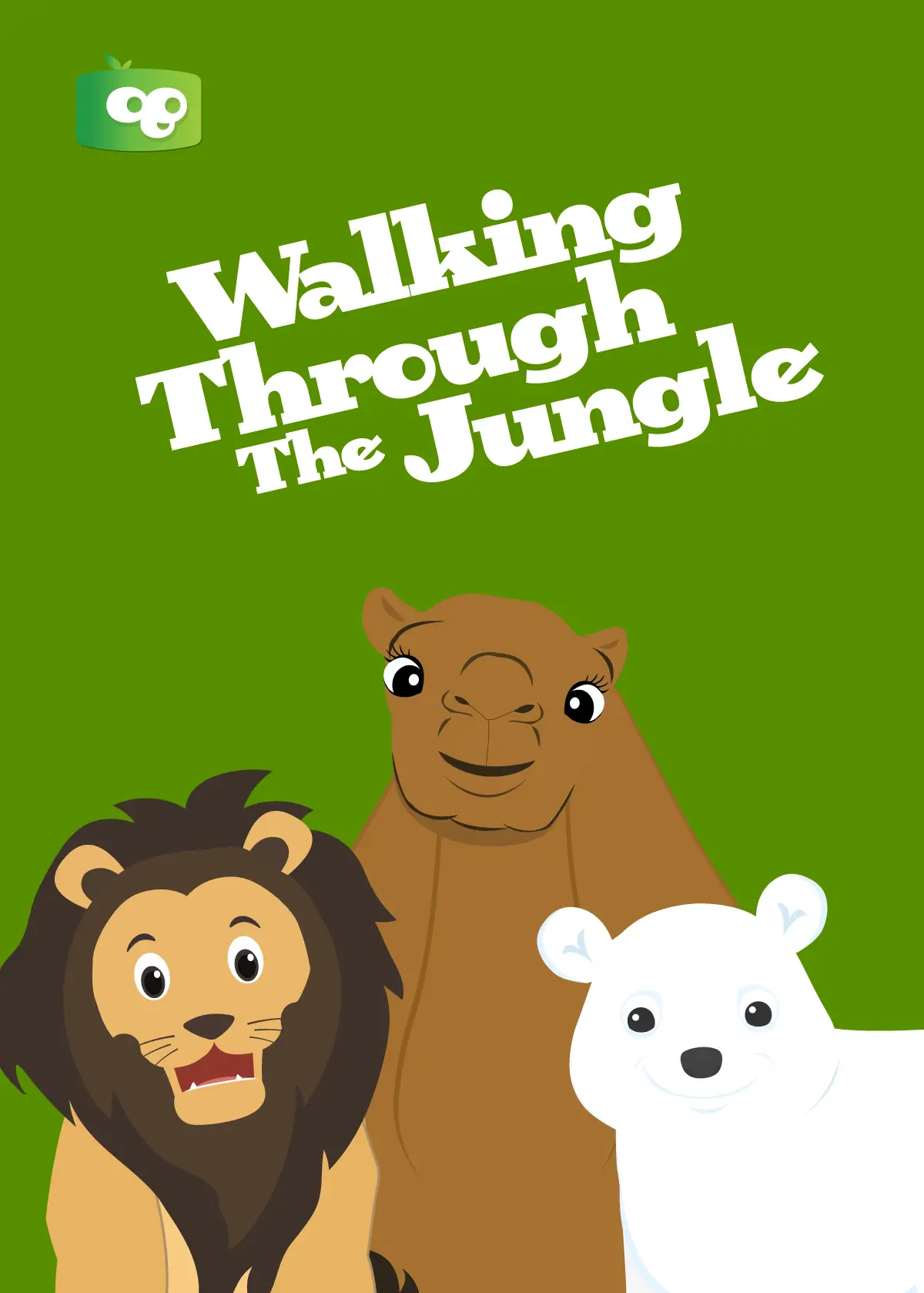
- Identifies 7 animals: lion, whale, wolf, crocodile, snake, camel, polar bear
- Matches animals to their habitats (jungle, ocean, mountain, river, forest, desert, iceberg)
- Learns action verbs: walking, floating, climbing, swimming, trekking, slipping
- Builds geographic awareness through diverse environments
- Develops listening skills through call-and-response song structure
They'll use these skills when:
- Visiting a zoo and recognizing animals from the video
- Reading picture books about animals and pointing out where they live
- Playing with toy animals and sorting them by habitat
- Talking about nature documentaries or outdoor discoveries
The Story (what keeps them watching)
It's time for an around-the-world adventure! Our explorer travels through seven incredible places—starting in the steamy jungle where a lion appears, then floating across the vast ocean to spot a whale. The journey continues up a mountain (hello, wolf!), through a river with a sneaky crocodile, into a forest where a snake slithers by, across a sandy desert with a camel, and finally sliding on an iceberg with a polar bear. After all that excitement, it's time to run home for dinner and share every amazing thing discovered along the way!
How We Teach It (the clever part)
- First minute: Introduces the adventure format with jungle and ocean habitats, establishing the "What do you see?" pattern that invites participation
- Minutes 1-2: Builds momentum through mountain, river, and forest environments, reinforcing the habitat-animal connection with repetitive structure
- Final minute: Completes the journey through desert and iceberg, then celebrates the adventure with a satisfying "I've been around the world" conclusion
Teaching trick: The repetitive "What do you see?" question creates an anticipation pause—giving children a moment to guess the animal before the reveal. This active prediction strengthens memory and keeps little minds engaged.
After Watching: Quick Wins to Reinforce Learning
- Mealtime activity: "Can you walk your fingers across your plate like you're walking through the jungle?" (Practices the movement verbs from the song while making mealtime playful)
- Car/travel activity: "Look out the window—do you see any animals? Where do they live?" (Extends habitat awareness to real-world observation and builds connection between video learning and everyday life)
- Bedtime activity: "If you could visit one place from the song—jungle, ocean, mountain, river, forest, desert, or iceberg—which would you pick? What animal would you see?" (Reinforces habitat-animal pairs through imagination and conversation)
- Anytime activity: Gather stuffed animals or toy figures and sort them: "Does this one live somewhere hot or cold? Wet or dry?" (Hands-on classification practice that extends learning beyond the screen)
When Kids Get Stuck. And How to Help.
- "My child can't remember which animal goes where." - Totally normal! Focus on just one or two favorites first. Ask "Where does the polar bear live?" and celebrate when they remember "somewhere cold!" Exact habitat names come with repetition.
- "They just want to watch it over and over." - Great news—that's how learning sticks! Each repeat viewing strengthens those animal-habitat connections. Try asking different questions each time to deepen understanding.
- "The vocabulary seems advanced for my toddler." - Words like "trekking" and "iceberg" are stretch vocabulary, and that's intentional. Young children absorb more than they can say. They'll understand context first, then use the words later.
What Your Child Will Learn
Prerequisites and Building Blocks
This video works beautifully as an introduction to animal and habitat concepts—no prerequisites needed! Children who have basic animal recognition (knowing what a lion or whale looks like) will connect faster, but the visual pairing teaches newcomers effectively. This builds toward more detailed habitat studies, animal classification by features, and eventually understanding ecosystems. It pairs perfectly with other Kokotree animal videos and nature content.
Cognitive Development and Teaching Methodology
The call-and-response structure ("What do you see?") leverages children's natural desire to participate and predict. Repetitive verse patterns support memory encoding—a key principle for ages 1-6. The video addresses visual learners through vibrant habitat imagery, auditory learners through the catchy melody and clear lyrics, and kinesthetic learners through implied movement (walking, climbing, swimming) that children naturally mimic.
Alignment with Educational Standards
This video supports early science standards for life science, specifically understanding that animals live in different places suited to their needs. It aligns with kindergarten readiness indicators for vocabulary development and listening comprehension. The content addresses Head Start Early Learning Outcomes Framework domains of Scientific Reasoning and Language & Literacy through nature vocabulary and descriptive language exposure.
Extended Learning Opportunities
Pair this video with printable habitat sorting worksheets where children draw lines connecting animals to environments. The Kokotree app features related animal identification games and habitat matching activities. Extend learning with a simple craft: draw seven "windows" on paper and have children draw one animal in each habitat. Nature walks become richer when children look for local animal homes.
Transcript Highlights
- "Walking through the jungle... What do you see? I think I see a lion" — Models observation and identification language
- "Floating on the ocean... I think I see a whale" — Introduces habitat-specific movement vocabulary
- "I've been around the world and back, and guess what I've seen?" — Celebrates learning and invites recall
- "Slipping on the iceberg... I think I see a polar bear" — Connects cold-weather vocabulary to appropriate animal
Character Development and Story Arc
The unseen explorer models curiosity and bravery—venturing into unfamiliar environments with excitement rather than fear. Each "chasing after me" moment adds playful tension while showing that animals in their habitats are fascinating to discover. The return home for dinner models a complete adventure arc: explore, discover, return, and share. This demonstrates that learning about the world is an adventure worth talking about.
Animals and Habitats: A Deep Dive into Early Science Learning
Understanding that different animals live in different places is a foundational concept in early childhood science education. This video introduces seven distinct biomes in an age-appropriate way: tropical jungle, ocean, mountain, freshwater river, temperate forest, desert, and polar regions.
For young children, the concept of "habitat" begins simply: some places are wet, some are dry; some are hot, some are cold. The animals featured were carefully selected as iconic representatives: lions are synonymous with African grasslands and jungles, whales immediately evoke ocean imagery, polar bears are unmistakably arctic. These strong associations help cement the habitat concept.
The movement verbs—walking, floating, climbing, swimming, trekking, slipping—aren't just fun; they describe how animals and humans navigate different terrains. A child who learns "floating on the ocean" begins understanding that water environments require different movement than land.
Research shows that children develop geographic and environmental awareness gradually, starting with familiar/unfamiliar distinctions before understanding climate and terrain. This video scaffolds that development by presenting clear visual and verbal contrasts: the lush green jungle versus the sandy yellow desert, the flowing river versus the solid iceberg.
The global journey format also plants early seeds for understanding Earth's diversity—that our planet contains many different places, each with unique animals perfectly suited to live there. This wonder-based approach to science builds the curiosity that drives deeper learning in later years.