
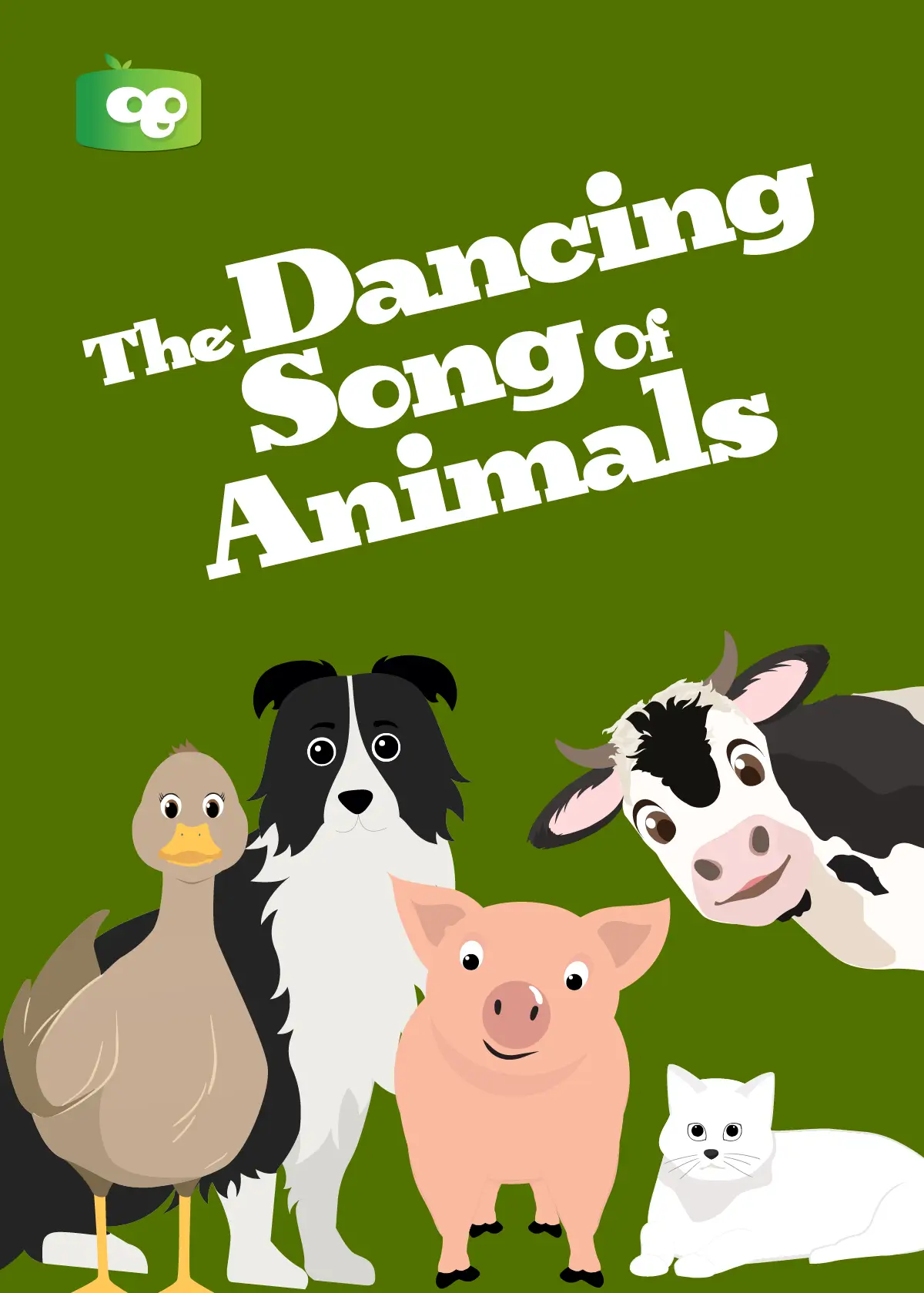
What's The Dancing Song of Animals About?
Get ready to wiggle, stomp, and dance! Your little one will meet a parade of friendly animals, learn their special sounds, and discover how each creature moves—all while counting along and building body coordination.
2.5 minutes
Ages 1-6
Skill: Animal sounds, movement, and counting
Your kid watches animals dance and make their sounds. You get 2.5 minutes to finish that cup of coffee.
Colorful animated animals appear one by one—a meowing cat, a swimming crocodile, a woofing dog, an oinking pig, a tall elephant, a mooing cow, a neighing horse, and a web-spinning spider. Each animal introduces itself with its signature sound while fun music plays. The catchy chorus invites kids to dance "wild and free" while counting "one and two and three."
What your child learns:
This video turns animal recognition into an active, full-body experience. Children don't just hear animal sounds—they're encouraged to move, count, and imitate, which strengthens memory and builds connections between words, sounds, and movement.
- Identifies 8 different animals by sight and sound
- Matches animals to their correct sounds (meow, woof, moo, neigh, oink)
- Practices counting to three with the beat
- Develops gross motor skills through dancing movements
- Builds listening skills by following musical cues
They'll use these skills when:
- Visiting a farm, zoo, or petting area and naming animals they see
- Reading picture books and making the animal sounds on each page
- Playing pretend games where they "become" different animals
- Following instructions in music class or group activities
The Story (what keeps them watching)
It's a dance party, and every animal wants to show off their moves! First, a playful cat struts in with confident meows. Then a crocodile glides through with a mischievous grin. A friendly dog bounds in barking, followed by a cheerful pig oinking along. The tall elephant reminds everyone just how big it is, while a cow and horse join the fun with their barnyard sounds. Finally, a clever spider spins into the scene. Between each animal, the catchy chorus gets everyone dancing and counting together—one, two, three!
How We Teach It (the clever part)
- First 50 seconds: Introduces the cat and crocodile with their sounds, establishing the pattern of "I'm a [animal], I go [sound]." The chorus teaches the counting rhythm.
- Minutes 1-2: Builds complexity by introducing more animals (dog, pig, elephant), each with distinctive sounds and characteristics like the elephant's trunk and height.
- Final 30 seconds: Reinforces learning with farm animals (cow, horse) and ends with the unique spider, showing variety in the animal kingdom.
Teaching trick: Each animal introduces itself using the same sentence structure ("I'm a [animal], I go [sound]"), creating a predictable pattern that helps toddlers anticipate and join in. Repetition of sounds three times (meow meow meow) gives little ones time to process and imitate.
After Watching: Quick Wins to Reinforce Learning
- Mealtime activity: "What sound does a cow make? Can you moo three times before your next bite?" (Practices animal sounds and counting while keeping meals fun)
- Car/travel activity: "I spy an animal! What sound does a dog make?" Point out real animals or animal pictures and have your child make the matching sound. (Connects video learning to real-world recognition)
- Bedtime activity: "Let's say goodnight to the animals! Goodnight cat—meow! Goodnight horse—neigh!" Go through each animal from the video. (Reviews all animals while creating a calming routine)
- Anytime activity: "Show me how an elephant walks! Now dance like a cat!" Take turns picking animals and moving like them around the room. (Builds gross motor skills and animal association)
When Kids Get Stuck. And How to Help.
- "My child just watches but won't dance or make sounds." - Totally normal! Many children observe several times before participating. Try dancing yourself and making the sounds—they're more likely to join when they see you having fun.
- "They mix up which sound goes with which animal." - Animal sounds take time to stick. Focus on just 2-3 animals at first (cat, dog, cow are easiest). Use stuffed animals or pictures and practice those sounds throughout the day.
- "The crocodile and spider parts seem too tricky for my toddler." - Those verses have more complex language, which is intentional! Younger children will focus on the simpler animals first, while older kids engage with the trickier ones. The video grows with your child.
What Your Child Will Learn
Prerequisites and Building Blocks
This video works beautifully as an early introduction to animal recognition—no prior knowledge needed! Children who have watched basic animal videos or read animal picture books will recognize familiar friends. This video builds foundational skills that connect to later learning about animal habitats, animal classification (farm animals vs. wild animals), and more complex counting sequences. It bridges passive animal recognition toward active recall and imitation.
Cognitive Development and Teaching Methodology
The call-and-response structure ("I'm a cat, I go meow") leverages echoic memory, helping toddlers retain information through repetition. Movement-based learning activates kinesthetic pathways, making abstract concepts (animal = sound) concrete and memorable. The predictable pattern reduces cognitive load, allowing children to anticipate what comes next—a key confidence builder. Visual, auditory, and physical learning styles are all engaged simultaneously.
Alignment with Educational Standards
This video supports kindergarten readiness indicators for science (identifying common animals and their characteristics) and language development (vocabulary building, sound discrimination). It aligns with early learning standards for gross motor development and musical awareness. Teachers expect incoming kindergarteners to identify basic animals and their sounds—this video directly builds that benchmark skill through engaging repetition.
Extended Learning Opportunities
Pair this video with animal matching games in the Kokotree app for reinforced learning. Print simple animal flashcards and play "What sound does this make?" Create a movement game where you call out animals and children must move like them. Visit a local farm or watch nature documentaries to see real versions of these animals. Draw and color the animals while practicing their sounds.
Transcript Highlights
- "I go meow meow meow, meow meow meow, meow meow meow, I'm a cat" — Clear, repetitive introduction establishing the animal-sound connection
- "I'm dancing like an animal, look at me, wild and free, dancing like an animal, one and two and three" — Combines movement invitation with counting practice
- "I'm an elephant, with a trunk and all, you look very small, cause I'm very tall" — Introduces physical characteristics and size comparison concepts
- "I'm a spider, spinning in a web, I got eight long legs" — Teaches specific animal features (eight legs) building early science knowledge
Character Development and Story Arc
Each animal character models confident self-expression—they proudly announce who they are and demonstrate their unique sounds without hesitation. The crocodile shows playful mischief ("better run and hide"), while the elephant demonstrates gentle awareness of others ("could you move aside?"). The spider shows problem-solving by heading home when hungry. These brief character moments model self-identification, spatial awareness, and simple decision-making for young viewers.
Animal Sound Recognition and Early Language Development Deep Dive
Animal sounds (onomatopoeia) serve as a crucial bridge in early language development. When children learn that a cat says "meow" and a dog says "woof," they're practicing phonemic awareness—the understanding that specific sounds carry meaning. This skill directly transfers to letter-sound recognition needed for reading.
The repetition structure in this video ("meow meow meow" repeated multiple times) isn't just catchy—it's scientifically designed. Young brains need 6-12 exposures to new information before it moves into long-term memory. By repeating each animal sound three times within a verse, and featuring the chorus multiple times, children receive the repetition they need within a single viewing.
Movement paired with learning creates "embodied cognition"—when children dance like an elephant or stomp like a horse, they're encoding that information through multiple neural pathways. Research shows that children who physically act out concepts retain information 20-30% better than those who only watch or listen.
The counting element ("one and two and three") introduces mathematical concepts naturally. Children practice one-to-one correspondence as they count beats, building number sense that supports later math learning. The rhythm helps internalize counting sequences, making numbers feel natural and fun rather than abstract.
This video also builds categorical thinking. Children begin recognizing that cats, dogs, cows, and horses are all "animals" despite looking and sounding different—an early classification skill that supports scientific thinking and vocabulary organization.