
What's Habitats About?
Your child joins two adventurous friends on a balloon ride around the world, rescuing animals stuck in the wrong homes. They'll learn to match animals to their natural environments—from icy tundras to sunny savannahs!
10 minutes
Ages 5-6
Skill: Understanding where animals live and why
Your kid watches animals find their perfect homes around the world. You get 10 minutes to finish that coffee in peace.
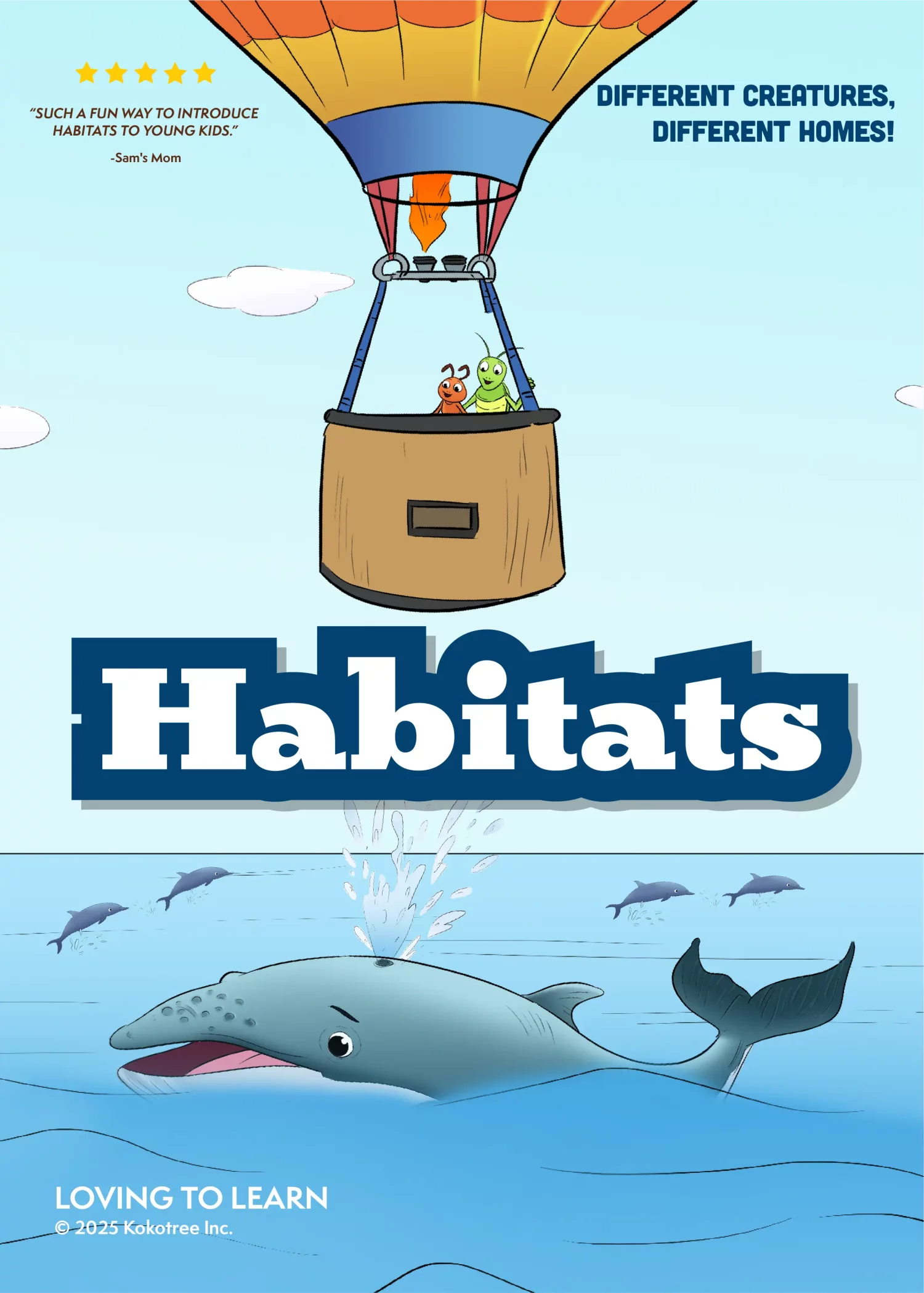
Andy the Ant and Greg the Grasshopper soar in a colorful hot-air balloon, visiting forests, deserts, tundras, oceans, and rainforests. Along the way, they find confused animals—like a sweating penguin in the desert and a shivering monkey in the snow—and help each one get back to where they belong.
What your child learns:
This video introduces the concept that every animal has a special place called a habitat where it can find food, shelter, and the right climate. Children discover that a camel needs hot sand, a penguin needs ice, and a whale needs deep ocean water—building foundational understanding of ecosystems and animal adaptation.
- Identifies 7 different habitats: forest, desert, tundra, savannah, ocean, beach, and rainforest
- Matches specific animals to their correct environments
- Understands why certain animals can't survive in the wrong habitat
- Recognizes key features of each habitat (hot/cold, wet/dry, grassy/icy)
- Develops early scientific reasoning about animal needs
They'll use these skills when:
- Visiting a zoo and explaining why polar bears have a cold enclosure
- Reading animal books and predicting where a new animal might live
- Playing with toy animals and sorting them into habitat groups
- Watching nature documentaries and recognizing different environments
The Story (what keeps them watching)
Wise Owl has a problem—animals everywhere are lost in the wrong habitats! A camel is sneezing in a leafy forest, a penguin is melting in the desert, and a whale is flopping around in the grasslands. Andy the Ant and Greg the Grasshopper take off in a hot-air balloon to save the day. Each rescue brings laughs (that whale splash!) and learning as the duo figures out exactly where each animal belongs. By sunset, every creature is home safe, and your little explorer understands why habitats matter.
How We Teach It (the clever part)
First 3 minutes: Miss Meera introduces the concept of habitats as "special homes for living things," connecting it to Ruby's love of grassy gardens. This personal connection makes the abstract concept concrete before the adventure begins.
Minutes 3-8: Each animal rescue follows a pattern: spot the problem, identify why the habitat is wrong, name the correct habitat, and celebrate the solution. Repetition with variety helps concepts stick.
Final 2 minutes: The classroom wrap-up reinforces that "every habitat is special" and connects back to the children's own experiences, helping kids see themselves in the lesson.
Teaching trick: The video uses dramatic contrast—a penguin panting in desert heat, a monkey shivering with frozen bananas—to make habitat mismatches memorable and slightly silly. Kids remember what made them laugh!
After Watching: Quick Wins to Reinforce Learning
Mealtime activity: "If you were a penguin, would you want to eat dinner somewhere hot or cold?" (Practices connecting animal needs to environment features)
Car/travel activity: "Look out the window—what animals could live here? Would a camel be happy or a frog?" (Applies habitat knowledge to real surroundings)
Bedtime activity: "Let's think of three animals and their homes before sleep—where does a whale live? A monkey? A camel?" (Reinforces animal-habitat pairs through recall)
Anytime activity: Sort toy animals into "hot home" and "cold home" piles using a blanket as a divider. (Kinesthetic learning through play)
When Kids Get Stuck. And How to Help.
"My child thinks any animal can live anywhere" - This is developmentally normal! Start with extremes: "Could a fish live in your bedroom? Why not?" Building from obvious examples helps them grasp that animals have specific needs.
"They mix up desert and savannah" - Both are warm, so this is tricky! Focus on one key difference: "Desert = mostly sand, savannah = tall grass." Use hand motions—flat palm for sand, wiggly fingers for grass.
"Seven habitats seems like a lot to remember" - It is! Focus on the three most different ones first (ocean, desert, tundra). Once those click, the others will follow naturally over repeated viewings.
What Your Child Will Learn
Prerequisites and Building Blocks
Children watching this video should have basic familiarity with common animals (camel, penguin, monkey, whale, frog) and understand simple weather concepts like hot and cold. This lesson builds on earlier Kokotree content about animals and nature, extending knowledge from "what animals look like" to "where animals live and why." It serves as a foundation for future lessons on ecosystems, food chains, and environmental science in the Grade 1 curriculum.
Cognitive Development and Teaching Methodology
At ages 5-6, children are developing classification skills and cause-effect reasoning—both essential for understanding habitats. The video uses a problem-solution narrative structure that matches how young minds naturally process information. Visual learners benefit from distinct habitat imagery; auditory learners absorb the repeated habitat names; kinesthetic learners engage through the balloon journey's movement. The emotional hook of "helping lost animals" activates empathy-driven attention.
Alignment with Educational Standards
This video addresses Next Generation Science Standards for K-2, specifically "where animals live and why they live there" (2-LS4-1). It supports kindergarten readiness indicators for science vocabulary and environmental awareness. Teachers expect entering first graders to identify basic animal needs (food, water, shelter) and recognize that different environments support different life—exactly what this lesson delivers through engaging storytelling.
Extended Learning Opportunities
Pair this video with Kokotree's printable habitat sorting worksheets, where children cut and paste animals into correct environments. The app's "Habitat Match" game reinforces learning through interactive play. Extend beyond screens with a nature walk to observe local habitats, or create a shoebox diorama of one habitat. Library books about specific biomes make excellent follow-up reading for curious learners.
Transcript Highlights
- "Habitats are the special places where living things — animals, plants, even people — make their homes." (Clear, child-friendly definition)
- "This forest habitat isn't right for you — your habitat is the desert!" (Models problem identification and solution)
- "The tundra — cold, icy, and perfect for penguins!" (Connects habitat features to animal needs)
- "Every habitat is special. Just like animals, we all need the right place to live and grow." (Universal takeaway message)
Character Development and Story Arc
Andy and Greg model scientific curiosity and helping behavior throughout their journey. When faced with each misplaced animal, they don't panic—they observe ("Is that a camel?"), identify the problem ("This isn't right for you"), and take action ("Let's get you home"). Their teamwork demonstrates collaborative problem-solving, while their humor (getting splashed by the whale) shows that learning can be fun. The characters grow from surprised observers to confident habitat experts by journey's end.
Understanding Habitats: A STEAM Deep Dive
Habitats represent one of the foundational concepts in life science education, connecting biology, geography, and environmental science in ways young children can grasp. This video introduces the scientific principle of adaptation—the idea that animals have specific physical and behavioral traits that help them survive in particular environments.
The seven habitats featured (forest, desert, tundra, savannah, ocean, beach, rainforest) represent Earth's major biomes, each with distinct characteristics:
Climate factors: Temperature and precipitation define habitats. The video emphasizes this through contrast—the penguin's distress in desert heat versus joy in tundra cold demonstrates that animals are adapted to specific temperature ranges.
Physical features: Each habitat has recognizable landmarks. Forests have tall trees, deserts have sand dunes, tundras have ice, savannahs have grasslands, and oceans have waves. These visual markers help children categorize environments.
Animal adaptations: Though not explicitly named, the video hints at adaptations. Camels thrive in deserts because they're built for heat and sand. Penguins have bodies designed for cold and swimming. Whales need water to support their massive bodies and find food.
Ecological relationships: The concept that animals "belong" somewhere introduces the idea of ecological niches—each species has a role in its habitat's web of life.
This foundational understanding prepares children for more complex concepts later: food chains, predator-prey relationships, migration, and eventually, conservation and human impact on habitats. By starting with the simple question "Where does this animal live?", children build mental frameworks for understanding our planet's incredible biodiversity.