
What's Money Magic About?
Your child joins a fun classroom debate about coins and discovers the surprising truth—bigger isn't always better when it comes to money! Through an exciting jungle adventure, they'll learn to identify coin values and calculate change like a pro.
9 minutes
Ages 5-6
Skill: Understanding coin values and calculating change
Your kid watches animal friends shop for royal birthday gifts. You get 9 minutes to enjoy your coffee in peace.
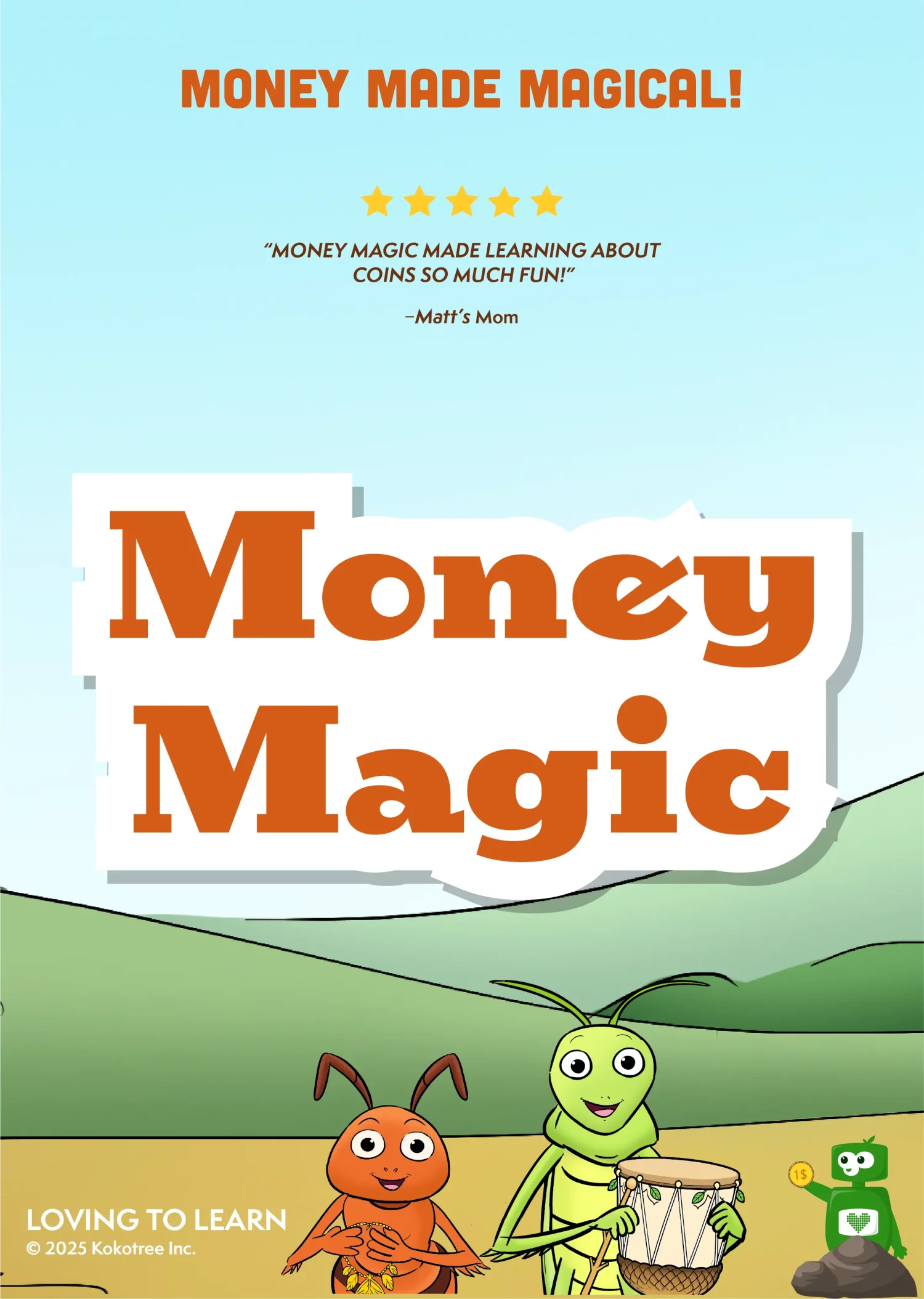
The video starts with a playful argument—Maddy thinks more coins means more money, while Rubby believes bigger coins are worth more. Miss Meera reveals the truth through a magical story about Andy the Ant and Greg the Grasshopper, who must buy gifts for the Forest Queen using real coins from different countries.
What your child learns:
Your child discovers that a coin's value isn't determined by its size or how many you have—it's about the number printed on it. They'll practice real-world math by watching characters count coins and calculate change at a marketplace.
- Identifies US coins (penny, nickel, dime, quarter) and their values
- Recognizes UK coins (pence and pounds) and understands currency differences
- Calculates change using subtraction (100 - 75 = 25)
- Understands that smaller coins can be worth more than larger ones
- Applies addition to combine coin values
They'll use these skills when:
- Counting coins in a piggy bank at home
- Playing pretend store with toys and play money
- Helping at a garage sale or lemonade stand
- Understanding why different items cost different amounts at the shop
The Story (what keeps them watching)
Maddy and Rubby argue about who's richer—Maddy with 70 pennies or Rubby with one shiny coin. Miss Meera settles it with a story about Andy the Ant and Greg the Grasshopper, who must buy birthday gifts for the Forest Queen. Wise Owl teaches them about US and UK coins, and the friends visit Beth the Butterfly's shop to practice real purchases. Andy buys a Sparkling Leaf Necklace for 75 cents and calculates his change from a dollar. Greg gets an Acorn Drum for 50p and figures out his change too. They deliver perfect gifts and prove they've mastered money math!
How We Teach It (the clever part)
- First 2 minutes: The classroom debate hooks kids with a relatable question—does more coins mean more money? Miss Meera introduces the concept that value matters most.
- Minutes 2-7: The jungle story shows coin identification for both US and UK currency, with clear visuals of each coin and its value. Shopping scenarios demonstrate real transactions.
- Final 2 minutes: Back in the classroom, kids answer change calculation questions, reinforcing the subtraction skills they just learned.
Teaching trick: The video uses a "wrong assumption" opener—kids naturally think more coins or bigger coins equal more money. By proving this wrong with specific examples (70 pennies vs. one dollar), the lesson sticks because it surprises them.
After Watching: Quick Wins to Reinforce Learning
- Coin sorting game: "Can you find the smallest coin that's worth the most?" Grab some real coins and let your child arrange them by size, then by value. Watch their surprise when they don't match!
- Car ride challenge: "If something costs 50 cents and you pay with a dollar, what's your change?" Practice mental subtraction with different amounts during your drive.
- Bedtime story extension: "If you were buying a gift for someone special, what would you choose?" Talk about how much things might cost and how they'd pay.
- Pretend shop anytime: Set up a mini store with toys and price tags. Give your child play coins and let them "buy" items and calculate their own change.
When Kids Get Stuck. And How to Help.
- "My child keeps thinking more coins equals more money." This is totally normal! Use real coins to show that five pennies (5 cents) is less than one dime (10 cents). Physical handling makes the abstract concept click.
- "The subtraction for change seems too hard." Start with round numbers like 50 and 100. Use fingers or counters to bridge the gap. "We have 100, we need 75, let's count up from 75 to 100!"
- "They're confused by different country currencies." Focus on one currency first (whichever you use at home). The concept that "different places use different money" is enough for now—mastering your local coins comes first.
What Your Child Will Learn
Prerequisites and Building Blocks
Children watching this video should already recognize numbers up to 100 and understand basic addition and subtraction concepts. This builds on earlier counting and number recognition videos in the Kokotree curriculum. The video bridges concrete counting skills with abstract value concepts—a key developmental step. It prepares children for more complex financial literacy lessons and multi-step word problems they'll encounter in Grade 1 and beyond.
Cognitive Development and Teaching Methodology
This video leverages the concrete-representational-abstract (CRA) teaching model perfect for 5-6 year olds. Children first see physical coins (concrete), then watch animated transactions (representational), and finally solve mental math problems (abstract). The story format activates episodic memory, making mathematical concepts more memorable. Multiple learning styles are addressed through visual coin displays, verbal explanations, and the kinesthetic suggestion of handling coins.
Alignment with Educational Standards
This video aligns with Common Core Math Standards for Kindergarten and Grade 1, specifically K.CC.A (counting and cardinality) and 1.NBT.C.4 (adding within 100). It addresses kindergarten readiness indicators for number sense and introduces measurement concepts (comparing values). Teachers expect entering first graders to understand that quantities can be represented different ways—this video directly builds that foundational understanding.
Extended Learning Opportunities
Pair this video with Kokotree's printable coin identification worksheets and "Make Change" activity sheets. The app's "Shopping Game" reinforces these skills through interactive play. Extend learning by creating a home store with real price tags, practicing coin rubbings for art integration, or reading picture books about money. Connect to other Kokotree videos on addition and subtraction to strengthen the underlying math skills.
Transcript Highlights
- Miss Meera explains value: "Ahhh… here's the magical money mystery: more coins don't always mean more money. And bigger coins? They aren't always richer either. It's all about the value."
- Wise Owl on currency: "That's called currency. And even though they look different, they all help us buy things."
- Real calculation modeled: "Two 50-cent coins make 100 cents. 100 cents minus 75 cents… that's 25 cents!"
- Key lesson reinforced: "Remember, it's not how many coins you have—or how big they are—it's their value that counts."
Character Development and Story Arc
Maddy and Rubby model a common childhood misconception, making the lesson relatable. Miss Meera demonstrates patient, inquiry-based teaching—she doesn't simply correct the children but guides them to discover the truth. Andy and Greg show curiosity and willingness to learn something new. Their successful shopping trip rewards their learning efforts, modeling a growth mindset. The Forest Queen's praise reinforces that knowledge and effort are valued.
Understanding Money: Mathematical Foundations for Young Learners
Money concepts represent one of the most practical applications of early mathematics, combining number recognition, place value understanding, addition, and subtraction into real-world scenarios. This video introduces several sophisticated mathematical ideas in age-appropriate ways.
The core concept—that numerical value differs from physical size or quantity—is foundational for mathematical thinking. A dime being worth more than a nickel despite being smaller challenges children's intuitive assumptions and builds flexible thinking. This cognitive flexibility transfers to other math concepts like fractions (where 1/2 can be larger than 1/4).
The video introduces multi-national currency, expanding children's worldview while reinforcing that the underlying mathematical principles remain constant. Whether counting pence or cents, the operations stay the same. This abstraction skill—seeing patterns across different representations—is crucial for higher mathematics.
Calculating change requires working backward from a total, a form of algebraic thinking. When Greg figures out that 70p minus 50p equals 20p, he's solving a simple equation. The video scaffolds this by having characters think aloud, modeling the mental math process.
The shopping context provides what educators call "authentic assessment"—children see math used for real purposes. Research shows that contextual learning improves retention and transfer. By embedding calculations in a fun narrative about birthday gifts, the video makes abstract operations meaningful and memorable.